Skip to content
Mechanics · Physics

Time of Flight, Height & Range (3D) Simulation

Launch from the ground or a roof in 3D, on Earth, the Moon or Mars. Read time up, time down, maximum height and range together, compare with the complementary angle, and see the level-ground rules fail from a height.

Interactive virtual lab · no download · works on phones and laptops

Chapter
Motion in a Plane
For
Class 11 · JEE · NEET
Time
~12 min

Time of Flight, Height & Range (3D) is a Pro simulation

Pro opens all 125 virtual labs — 483 simulations with guides and quizzes.

How to use it

  1. 1Set speed, angle, height and g, then press play.
  2. 2Load the worked example or the 39.2 m roof.

What to notice

  • On level ground time up = time down.
  • 30° and 60° share a range; 45° is best.
  • From a roof the fall takes longer than the rise.

For teachers

A ready-made teaching kit comes with this lab

  • Lesson plan

    19 min, 4 steps

  • Ask the class

    3 questions with answers

  • Quick quiz

    5 questions, printable

  • Key formulas

    3 formulas

About the Time of Flight, Height & Range (3D) simulation

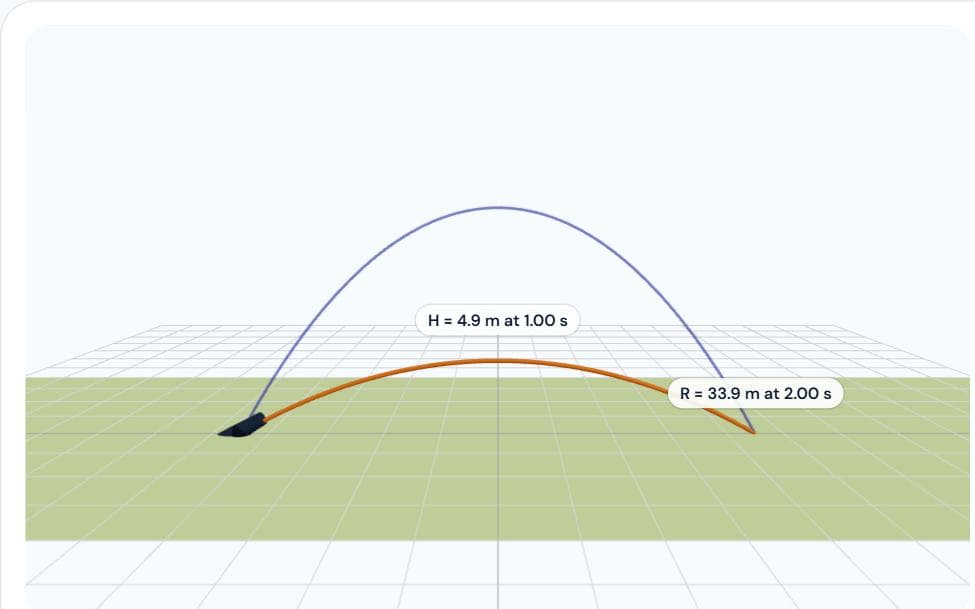
This 3D simulation puts time of flight, maximum height and range in one scene. Launch a ball at any speed and angle, from the ground or from a roof, on Earth, the Moon or Mars, and read the time up, the time down, the greatest height and the range together. The worked example (19.6 m/s at 30°) gives 1 s up, 2 s in the air and about 34 m.

On level ground the time up equals the time down, the range R = v² sin 2θ/g is the same for θ and 90° − θ (shown as a second path), and 45° goes furthest. Raise the launcher and these rules fail: the fall is longer than the rise, so the total time is no longer twice the time up, and the complementary angles no longer match.

Also covers: time of flight, maximum height, range of projectile, projectile from height, complementary angles same range, 45 degrees maximum range.
Frequently asked questions

Which angle gives the maximum range?

45° on level ground. From a height, a smaller angle goes further.

Do 30° and 60° give the same range?

Yes on level ground, because sin 60° = sin 120°. Not from a height.

What happens to range if the launch speed doubles?

On level ground it quadruples (R ∝ v²), while the time of flight only doubles.