Skip to content
Mechanics · Physics

Projectile Motion Simulation

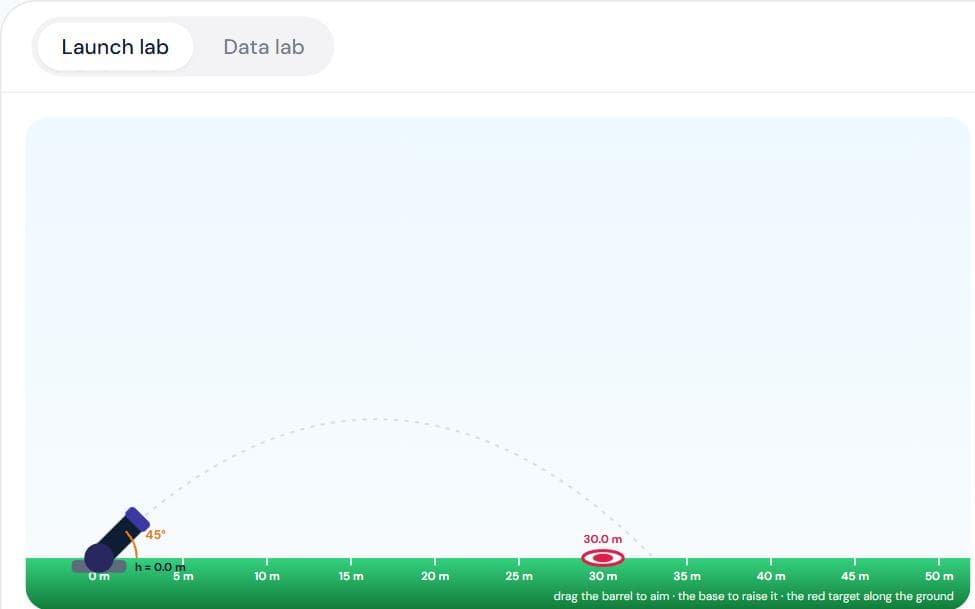
Fire a cannon at a target. Change angle, speed, height and mass, add air resistance, and read time of flight, range and maximum height at any point on the path.

Interactive virtual lab · no download · works on phones and laptops

Chapter
Motion in a Plane
For
Class 11 · JEE · NEET
Time
~15 min

Projectile Motion is a Pro simulation

Pro opens all 125 virtual labs — 483 simulations with guides and quizzes.

How to use it

  1. 1Set the angle and speed, then press Fire.
  2. 2Drag the target and try to hit it.
  3. 3Turn on velocity and acceleration vectors.
  4. 4Data lab: fire many shots with random spread and read the histogram.

What to notice

  • Without air, range is u² sin 2θ / g — largest at 45° from ground level.
  • Horizontal velocity stays constant; vertical velocity changes by g every second.
  • Complementary angles (30° and 60°) land at the same spot.
  • With drag, mass and size matter, and the best angle drops below 45°.

For teachers

A ready-made teaching kit comes with this lab

  • Lesson plan

    23 min, 4 steps

  • Ask the class

    4 questions with answers

  • Quick quiz

    7 questions, printable

  • Key formulas

    4 formulas

About the Projectile Motion simulation

A projectile is anything thrown or fired that then moves under gravity alone. Its motion splits into two independent parts: a steady horizontal velocity u cos θ that never changes (ignoring air), and a vertical motion that slows, stops at the top and speeds up again under g. Put the two together and the path is a parabola.

In this projectile motion simulation you set the launch angle, speed, height and mass, fire a cannonball or a football, and read off the range, maximum height and time of flight. Turn on air resistance to see why real shots fall short of the textbook answer and why the best angle drops below 45°. It covers Motion in a Plane (Class 11) and the projectile questions that appear in JEE Main and NEET every year.

Also covers: trajectory, range, angle of projection, air resistance, drag, cannon, data lab.

Frequently asked questions

Why does a projectile go furthest at 45°?

Range R = u² sin 2θ / g, and sin 2θ is largest (equal to 1) when 2θ = 90°, so θ = 45°. That is only true on level ground with no air resistance — with drag, or when launched from a height, the best angle is lower.

Why do 30° and 60° give the same range?

sin 2θ is the same for complementary angles: sin 60° = sin 120°. So any pair of angles adding up to 90° lands at the same spot, though the higher one stays in the air longer and climbs higher.

Does the mass of a projectile change its path?

Not without air resistance — every mass falls with the same acceleration g. With drag on, a heavier ball of the same size is slowed less, so it travels further.

What is the velocity of a projectile at its highest point?

Only the horizontal part, u cos θ. The vertical velocity is zero at the top, but the projectile is still moving sideways.