Skip to content
Mechanics · Physics

Pulley & Constraint Motion Simulation Lab

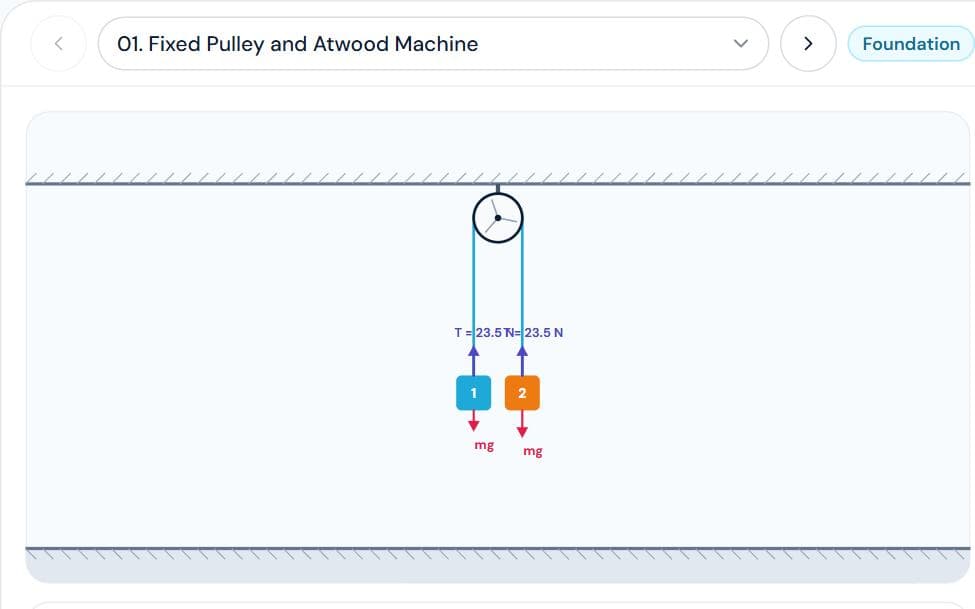
Fifteen pulley experiments on one engine that measures every string from its geometry — tangent runs and wrapped arcs — and differentiates it, so no constraint is memorised. Atwood machines, movable and compound pulleys, pulleys riding on wedges and platforms, the truck, stepped-block and wedge-chain figures, a tiny-displacement builder, a build-your-own editor, a JEE challenge lab, slipping strings and when tensions are equal. Every arrangement also runs in 3D.

Interactive virtual lab · no download · works on phones and laptops

Chapter
Laws of Motion (NLM)
For
Class 11 · 12 · JEE
Time
~40 min

Pulley & Constraint Lab is a Pro simulation

Pro opens all 125 virtual labs — 483 simulations with guides and quizzes.

How to use it

  1. 1Pick a module; drag the orange handles or press play to release under gravity.
  2. 2Read the live equation: it is computed from the drawing. Change the geometry and watch the coefficients change.
  3. 3Turn on coordinate arrows and choose 'downward as +' to see the signs flip.
  4. 4Use the 3D view to orbit any arrangement; build your own in module 12.

What to notice

  • Each independent string gives one equation: its length is constant.
  • A pulley mounted on a body moves with it; runs touching it change length.
  • For a straight run, dℓ = ê·(dr_B − dr_A); for big moves use the real new length.
  • The constraint links motions; Newton's laws (and torques for heavy pulleys) give the accelerations.
  • Equal tension across a pulley is an idealisation: massless, frictionless pulley and string.

For teachers

A ready-made teaching kit comes with this lab

  • Lesson plan

    37 min, 4 steps

  • Ask the class

    4 questions with answers

  • Quick quiz

    6 questions, printable

  • Key formulas

    5 formulas

About the Pulley & Constraint Lab simulation

Pulley problems are where JEE students most often memorise instead of reason: "a movable pulley halves the speed" is true only for vertical runs and a fixed anchor. This lab removes the memorising. Its engine measures every string from the actual geometry — the straight tangent runs between pulleys and the arcs it wraps — and differentiates that length, so the constraint for any arrangement, including diagonal strings, pulleys bolted to moving wedges and platforms, and several independent strings, comes out with the right coefficients.

The fifteen modules move from the Atwood machine and a single movable pulley, through the classic figures (a truck pulling a block over pulleys, a stepped block with wall pulleys, a wedge carrying a pulley, a wedge chain), to a tiny-displacement builder, an editor for building your own system, a JEE Advanced challenge lab, pulleys that turn and strings that slip, and a side-by-side comparison of when tensions are equal. Every simulation can be released under gravity, scrubbed in time and viewed in 3D.

Also covers: pulley, constraint motion, constrained motion, string constraint, atwood machine, movable pulley, block and tackle, compound pulley, wedge constraint, pulley on wedge, moving pulley, truck pulley problem, double atwood, tension in string, massive pulley, pulley rotation, slipping string, virtual displacement, jee advanced pulley.
Frequently asked questions

How do you find the constraint relation in a pulley problem?

Write the length of each string as the sum of its straight runs (plus constant wraps), using positions of the bodies the ends and pulleys sit on. Set each length constant and differentiate: one equation per independent string.

Does a pulley attached to a moving block count as fixed?

No. Its centre moves with the block, so every run that ends on it can change length when the block moves. That is why the pulley-on-wedge figure gives a = b.

When is the tension the same on both sides of a pulley?

When the string is massless and the pulley is massless (or not accelerating) with a frictionless axle. A heavy pulley that is speeding up, friction between string and pulley, or a heavy string all make the tensions differ.

Can the constraint equation give the acceleration?

No. It only links the bodies' motions. The accelerations and tensions come from Newton's laws (and the rotational equation for a massive pulley) solved together with the constraint.