Skip to content
Modern Physics · Physics

Quantum Coins & Measurement Simulation

Compare a biased classical coin with a quantum one prepared in a superposition. Measure one, then thousands, and see how the Bloch sphere sets the odds.

Interactive virtual lab · no download · works on phones and laptops

Chapter
Modern Physics (beyond syllabus)
For
Class 12 · Olympiad
Time
~10 min

Quantum Coins & Measurement is a Pro simulation

Pro opens all 125 virtual labs — 483 simulations with guides and quizzes.

How to use it

  1. 1Prepare the coin: set the bias, or the polar angle on the Bloch sphere.
  2. 2Flip or measure one coin, then 10, 100 or 10 000.
  3. 3Compare the measured fraction with the prediction.
  4. 4Measure twice in a row to see collapse.

What to notice

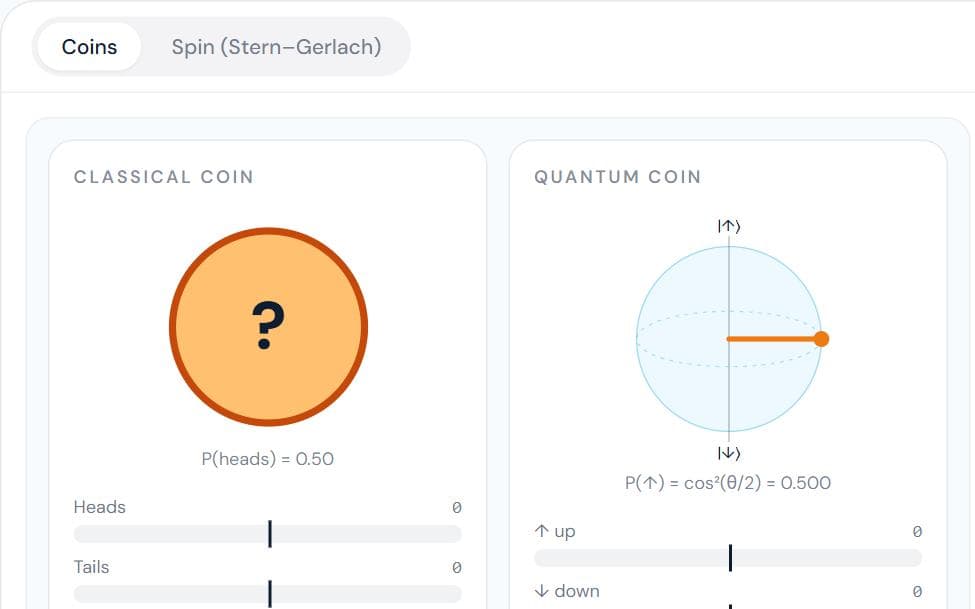
  • A classical coin already has a face before you look; a quantum coin does not.
  • Measuring a superposition gives one outcome, with probability |amplitude|².
  • After a measurement the state collapses: measuring again gives the same answer.
  • On the Bloch sphere, P(up) = cos²(θ/2).

For teachers

A ready-made teaching kit comes with this lab

  • Lesson plan

    19 min, 4 steps

  • Ask the class

    3 questions with answers

  • Quick quiz

    6 questions, printable

  • Key formulas

    1 formulas

About the Quantum Coins & Measurement simulation

A classical coin is already heads or tails before you look; a quantum system such as an electron's spin can be in a superposition, and measuring it gives one result with a probability set by its state. Measure it again along the same axis and you get the same answer; measure along another axis and the result is random again.

In this quantum coins and measurement simulation you compare classical and quantum coins, then send spins through Stern–Gerlach magnets in different orientations and predict the fractions that come out. It goes beyond the Class 12 syllabus — ideal for Olympiad preparation and the curious.

Also covers: quantum coin toss, superposition, bloch sphere, stern gerlach, spin, probability.
Frequently asked questions

What is a superposition?

A state that is a combination of possible outcomes; a measurement gives one of them with a definite probability.

What does a Stern–Gerlach magnet do?

It splits a beam of particles by spin — up or down along the magnet's axis.

Why does measuring along x after z give random results?

A definite z-spin is an equal superposition of the two x-spin states.