Skip to content
Coordinate Geometry · Mathematics

Radical Axis Simulation

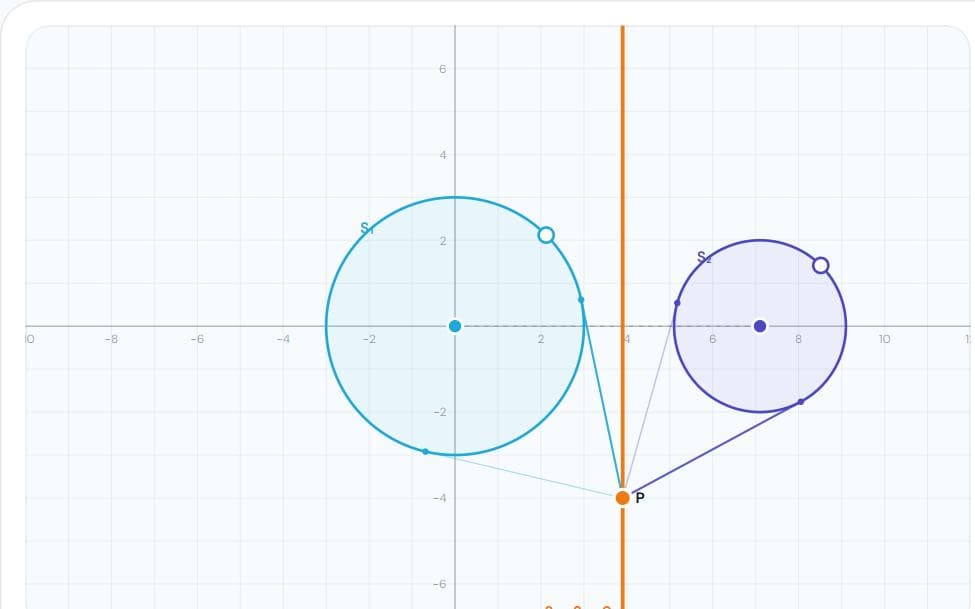
Drag two (or three) circles and watch the radical axis S₁ − S₂ = 0 move with them. Tangent lengths from any point on the axis stay equal.

Interactive virtual lab · no download · works on phones and laptops

Chapter
Circles
For
Class 11 · JEE
Time
~10 min

Radical Axis is a Pro simulation

Pro opens all 125 virtual labs — 483 simulations with guides and quizzes.

How to use it

  1. 1Drag a centre to move a circle; drag the ring handle to resize it.
  2. 2Drag the point P along the axis and compare the tangent lengths.
  3. 3Turn on the third circle to find the radical centre.

What to notice

  • The axis is always perpendicular to the line joining the centres.
  • When the circles intersect, the axis is their common chord.
  • From any point on the axis the two tangent lengths are equal.
  • Concentric circles have no radical axis.
  • Three circles with non-collinear centres share one radical centre.

For teachers

A ready-made teaching kit comes with this lab

  • Lesson plan

    20 min, 4 steps

  • Ask the class

    3 questions with answers

  • Quick quiz

    7 questions, printable

  • Key formulas

    2 formulas

About the Radical Axis simulation

The radical axis of two circles is the set of points from which the tangents to both circles have equal length — the points with equal power with respect to both. It is always a straight line perpendicular to the line of centres, found by subtracting the two circle equations. For three circles the three radical axes meet at the radical centre.

In this radical axis simulation you drag two or three circles, move a point P and see its tangents to each circle, keep P on the axis to check the tangents stay equal, and find the radical centre. It covers Circles in Class 11 coordinate geometry and JEE.

Also covers: coaxial circles, radical centre, power of a point.
Frequently asked questions

How do you find the radical axis of two circles?

Write both equations with x² + y² having coefficient 1 and subtract them: S₁ − S₂ = 0.

Is the radical axis perpendicular to the line of centres?

Always.

What is the radical axis of two intersecting circles?

Their common chord.