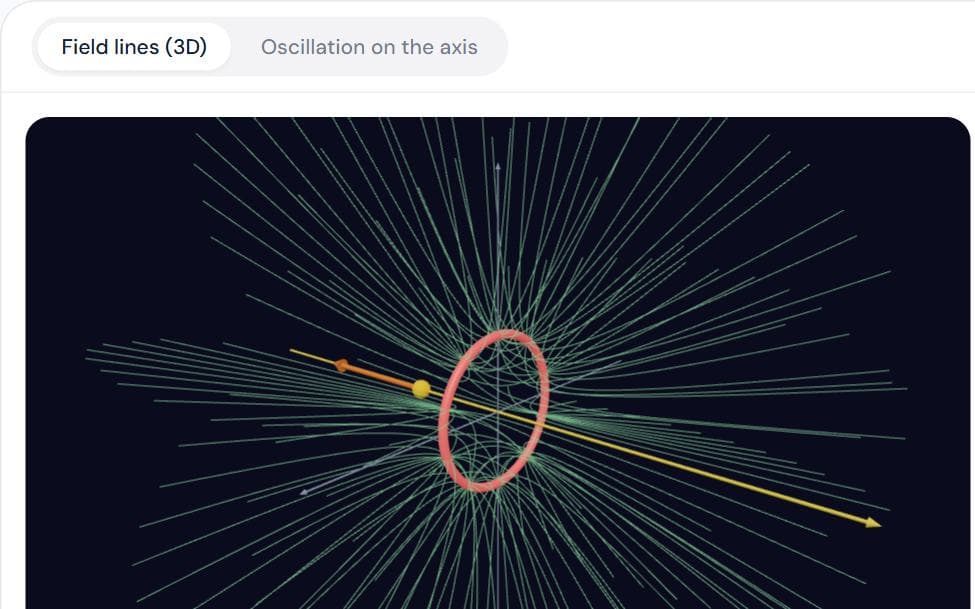
About the Electric Field of a Charged Ring simulation
A ring of uniform charge produces a field that is zero at its centre, because every bit of the ring is balanced by the bit opposite. Along the axis the sideways pulls cancel and the axial ones add, giving E = kQx/(x² + R²)^{3/2}, which peaks at x = R/√2 and falls off like a point charge's far away.
This charged ring simulation draws the field lines in 3D (traced from the ring's exact field and spun round the axis), moves a test charge along the axis, and plots E against x. Its second tab releases a negative charge on the axis: near the centre it oscillates in simple harmonic motion, and further out the swing slows down.
Also covers: field on axis of ring, ring of charge, maximum field r/root2, charge oscillating on axis of ring, electric field lines 3d.