Skip to content
Modern Physics · Physics

Rutherford Scattering Simulation

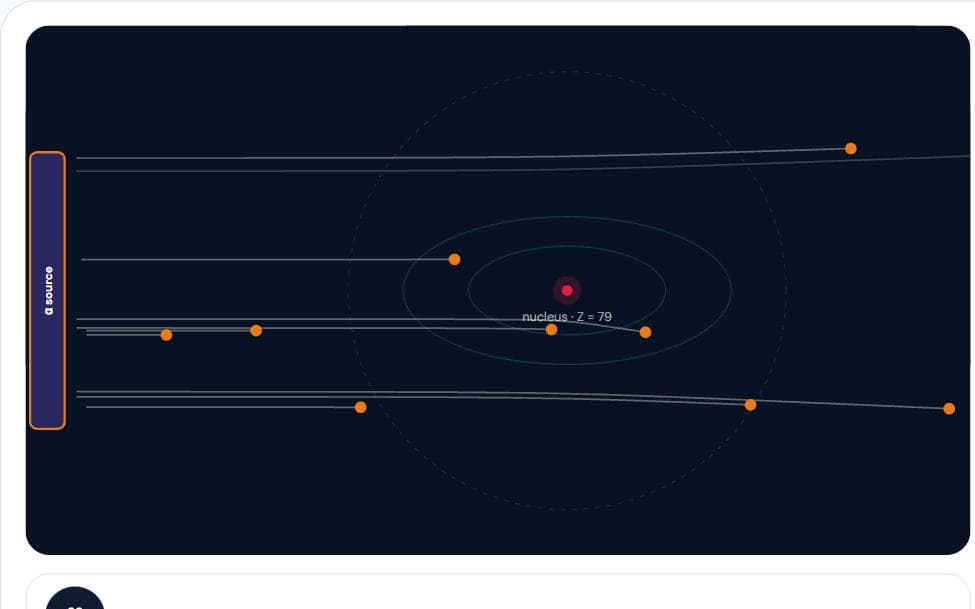
Fire alpha particles at an atom. With a tiny positive nucleus a few bounce right back; with Thomson's plum pudding they all sail through. That is how the nucleus was found.

Interactive virtual lab · no download · works on phones and laptops

Chapter
Atoms
For
Class 12 · JEE · NEET
Time
~10 min

Rutherford Scattering is a Pro simulation

Pro opens all 125 virtual labs — 483 simulations with guides and quizzes.

How to use it

  1. 1Choose the Rutherford atom or the plum-pudding atom.
  2. 2Switch on the gun.
  3. 3Change the alpha energy and the number of protons.
  4. 4Show the traces to see every path.

What to notice

  • Most alpha particles pass straight through: the atom is mostly empty.
  • Head-on particles bounce back — the positive charge sits in a tiny nucleus.
  • Smaller impact parameter → larger deflection.
  • Faster alphas or a smaller nuclear charge → less deflection.

For teachers

A ready-made teaching kit comes with this lab

  • Lesson plan

    19 min, 4 steps

  • Ask the class

    3 questions with answers

  • Quick quiz

    6 questions, printable

  • Key formulas

    1 formulas

About the Rutherford Scattering simulation

Rutherford fired alpha particles at thin gold foil. Most went straight through, but a few bounced back at large angles — impossible if the atom's positive charge were spread out as in Thomson's plum pudding model. He concluded that almost all the mass and positive charge sit in a tiny, dense nucleus.

In this Rutherford scattering simulation you fire alpha particles at a plum-pudding atom and at a nuclear atom, change the alpha energy and the number of protons, and count how many pass straight through, are deflected and bounce back. It covers Atoms in Class 12 and Structure of the Atom in Class 9 and 11, JEE and NEET.

Also covers: alpha particle, gold foil, nucleus, plum pudding, impact parameter, distance of closest approach.
Frequently asked questions

Why did most alpha particles pass straight through the foil?

The atom is mostly empty space; most alphas never come near a nucleus.

What did the few large deflections show?

That the positive charge is concentrated in a tiny nucleus that can repel an alpha strongly enough to turn it back.

How does a faster alpha particle behave?

It is deflected less and gets closer to the nucleus before turning.