Skip to content
Mechanics · Physics

Solar System 3D Simulation

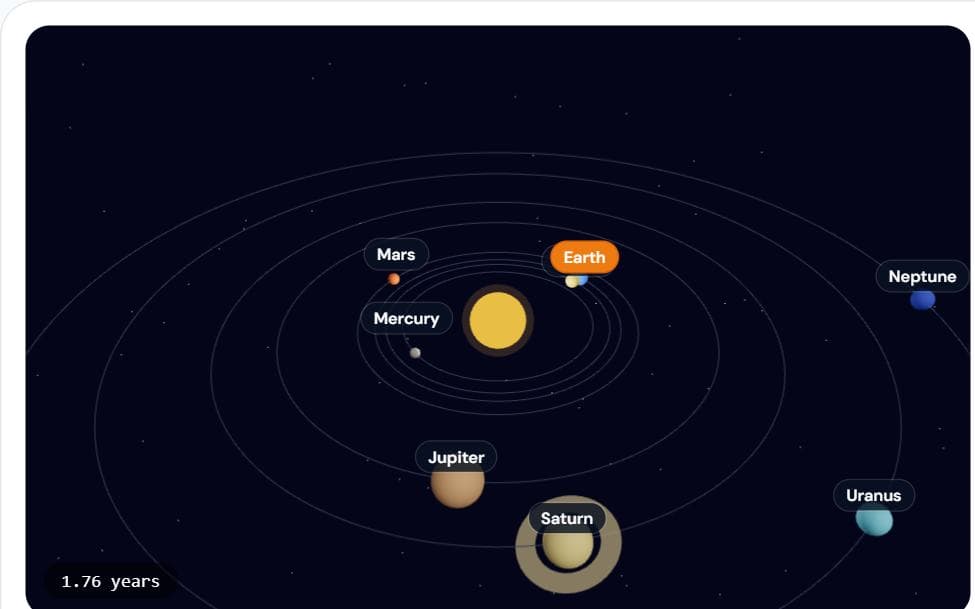
Fly around the Sun and its eight planets in 3D, each moving at its real relative speed. Follow any planet and check Kepler's third law, T² ∝ a³.

Interactive virtual lab · no download · works on phones and laptops

Chapter
Gravitation
For
Class 6 · Class 9 · Class 11
Time
~10 min

Solar System 3D is a Pro simulation

Pro opens all 125 virtual labs — 483 simulations with guides and quizzes.

How to use it

  1. 1Drag to turn, scroll or pinch to zoom.
  2. 2Click a planet or its name to follow it.
  3. 3Change the speed of time.
  4. 4Switch to true distances.

What to notice

  • Inner planets move faster and have shorter years.
  • T²/a³ is the same for every planet (1 in years and AU).
  • Orbital speed falls as √(1/a).
  • Sizes are exaggerated; distances can be shown to scale.

For teachers

A ready-made teaching kit comes with this lab

  • Lesson plan

    18 min, 4 steps

  • Ask the class

    3 questions with answers

  • Quick quiz

    5 questions, printable

  • Key formulas

    2 formulas

About the Solar System 3D simulation

The planets all go round the Sun the same way, but at very different speeds. Mercury finishes a year in 88 days; Neptune takes 165 of our years. Kepler found the rule in 1619: the square of a planet's period is proportional to the cube of its distance from the Sun. In years and astronomical units, T² = a³ for every planet.

This solar system simulation shows the eight planets in 3D, each moving at its real relative speed. Turn and zoom the view, click a planet to follow it and read its distance, period, orbital speed and moons, speed time up, and switch from compressed distances to true scale to see how empty the outer solar system is.

Also covers: solar system model, planets orbit speed, kepler third law, orbital period, planets 3d.
Frequently asked questions

Which planet moves fastest around the Sun?

Mercury, at about 47 km/s; Neptune, the slowest, moves at about 5.4 km/s.

What is Kepler's third law?

The square of a planet's orbital period is proportional to the cube of the semi-major axis of its orbit: T² ∝ a³.

How long is a year on Jupiter?

About 11.9 Earth years, since it is 5.2 AU from the Sun: 5.2³ ≈ 141 ≈ 11.9².