Skip to content
Mechanics · Physics

Minimum Force to Make a Block Slip Simulation

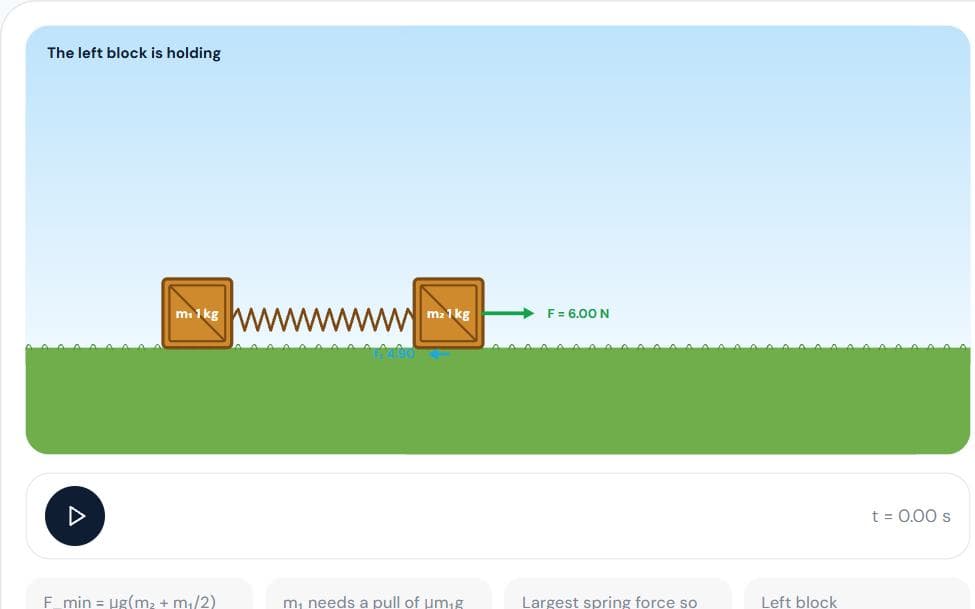
Two blocks joined by a spring sit on a rough floor, and a constant force pulls one of them along. Find the least force that ever moves the other block.

Interactive virtual lab · no download · works on phones and laptops

Chapter
Laws of Motion · Work, Energy and Power
For
Class 11 · JEE
Time
~10 min

Minimum Force to Make a Block Slip is a Pro simulation

Pro opens all 125 virtual labs — 483 simulations with guides and quizzes.

How to use it

  1. 1Set the masses, friction and spring constant.
  2. 2Choose the force, or jump 3 % below or above F_min.
  3. 3Apply the force and watch the spring-force graph.
  4. 4Turn on forces to see friction and the spring on each block.

What to notice

  • The answer is μg(m₂ + m₁/2), not μ(m₁ + m₂)g.
  • The pulled block overshoots: the spring stretches to 2(F − μm₂g)/k.
  • Static friction on the left block grows until it reaches μm₁g.
  • Work–energy, not force balance, gives the minimum.

For teachers

A ready-made teaching kit comes with this lab

  • Lesson plan

    18 min, 4 steps

  • Ask the class

    3 questions with answers

  • Quick quiz

    5 questions, printable

  • Key formulas

    2 formulas

About the Minimum Force to Make a Block Slip simulation

Two blocks rest on a rough floor, joined by a relaxed spring, and a constant force F pulls one of them. What is the least F that will ever move the other block? The tempting answer, μ(m₁ + m₂)g, is wrong. The pulled block overshoots like a mass on a spring and stretches the spring further than a slow pull would, so a smaller force is enough.

This simulation integrates the motion with stick–slip friction, shows the forces on each block, and plots the spring force against μm₁g. Set F just below and just above μg(m₂ + m₁/2) to see the left block hold and then give way — the work–energy theorem in action, a favourite JEE problem.

Also covers: two blocks spring friction, minimum force, spring block friction jee, work energy theorem, stick slip.
Frequently asked questions

What is the minimum force to move both blocks connected by a spring?

F = μg(m₂ + m₁/2). By work–energy on the pulled block, it stops at a stretch of 2(F − μm₂g)/k, where the spring must pull the other block with at least μm₁g.

Why is the answer not μ(m₁ + m₂)g?

That would be true for a slow, steady pull. A constant force applied suddenly makes the block overshoot its equilibrium, doubling the extension, so less force is needed.

Which theorem solves this problem?

The work–energy theorem: (F − μm₂g)x = ½kx² at the instant the pulled block momentarily stops.