Skip to content
Electricity · Physics

Static Electricity Simulation

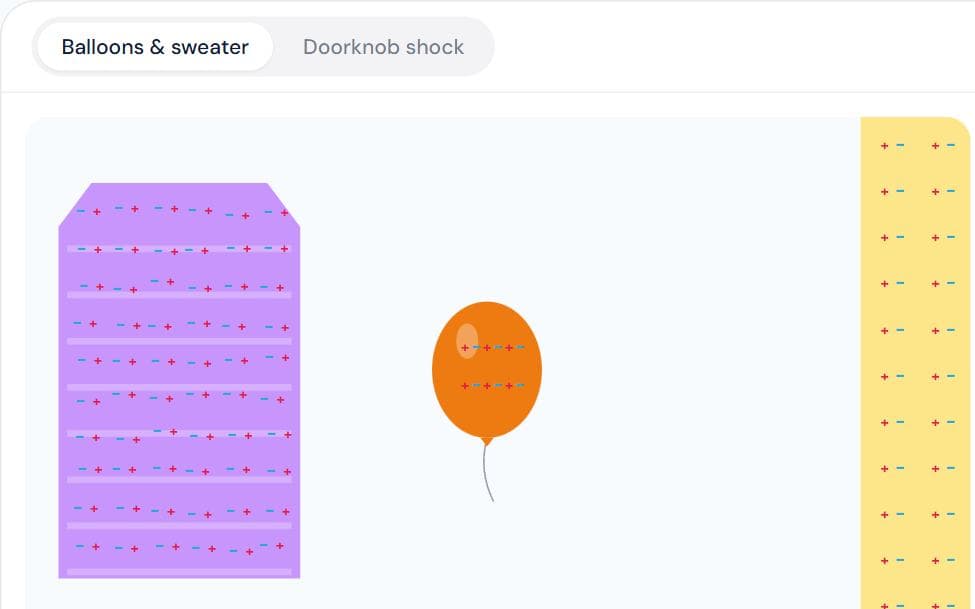
Rub a balloon on a sweater and watch electrons move, then stick it to the wall. Shuffle John's foot on a carpet until he gets a shock from the doorknob.

Interactive virtual lab · no download · works on phones and laptops

Chapter
Electric Charges and Fields
For
Class 8 · Class 12
Time
~10 min

Static Electricity is a Pro simulation

Pro opens all 125 virtual labs — 483 simulations with guides and quizzes.

How to use it

  1. 1Balloon: drag the balloon across the sweater, then toward the wall.
  2. 2Add a second balloon; remove the wall.
  3. 3John: drag his foot across the carpet, then move his hand near the doorknob.

What to notice

  • Rubbing moves electrons from one material to the other; no charge is created.
  • A charged balloon is attracted to a neutral wall because it induces charges there.
  • Like charges repel: two charged balloons push apart.
  • Charge leaps through the air as a spark when it gets close to a conductor.

For teachers

A ready-made teaching kit comes with this lab

  • Lesson plan

    19 min, 4 steps

  • Ask the class

    3 questions with answers

  • Quick quiz

    6 questions, printable

  • Key formulas

    0 formulas

About the Static Electricity simulation

Rubbing two materials together moves electrons from one to the other, leaving one negatively charged and the other positively charged. Charged objects attract or repel each other, and a charged object can even attract a neutral one by pushing the charges inside it slightly apart (induction).

In this static electricity simulation you rub a balloon on a sweater and watch the electrons move, stick the balloon to a wall, try two balloons, and build up charge on John by rubbing his foot on a carpet until a spark jumps to the doorknob. It suits Class 8 science and Electric Charges and Fields in Class 12.

Also covers: balloons and static electricity, john travoltage, charging by friction, induction, spark, discharge, grounding.
Frequently asked questions

Why does a rubbed balloon stick to a wall?

Its negative charge pushes electrons in the wall slightly away, leaving the nearby surface positive, which attracts the balloon.

Which way do electrons move when a balloon is rubbed on a sweater?

From the sweater to the balloon, so the balloon becomes negative and the sweater positive.

Why do you get a shock from a doorknob?

Charge built up on your body jumps to the metal knob as a spark when you get close.