Skip to content
Electricity · Physics

Van de Graaff Generator Simulation

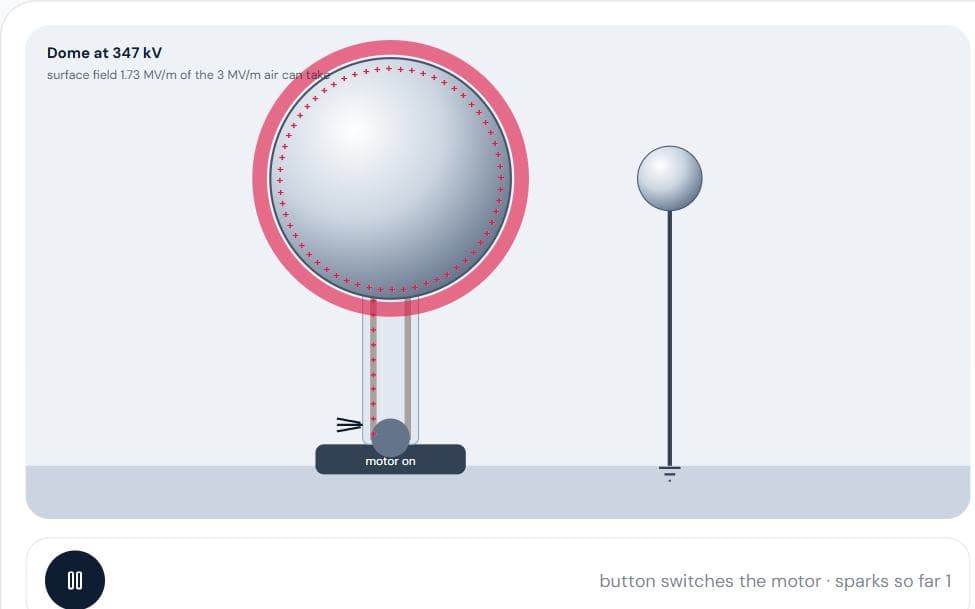
Run a Van de Graaff generator, watch charge ride the belt up to the dome and the voltage climb until a spark jumps across. Touch the dome and the hair rises.

Interactive virtual lab · no download · works on phones and laptops

Chapter
Electrostatic Potential and Capacitance
For
Class 12 · JEE · NEET
Time
~10 min

Van de Graaff Generator is a Pro simulation

Pro opens all 125 virtual labs — 483 simulations with guides and quizzes.

How to use it

  1. 1Set the belt's charge rate and the dome radius.
  2. 2Change the humidity.
  3. 3Bring an earthed sphere near to get sparks.
  4. 4Let a student touch the dome.

What to notice

  • Charge handed to the inside of the dome goes to its outer surface.
  • V = kQ/R; the surface field is V/R.
  • Air breaks down near 3 MV/m, so the largest voltage is about 3 MV/m × R.
  • Humid air leaks charge, so the voltage levels off lower.

For teachers

A ready-made teaching kit comes with this lab

  • Lesson plan

    18 min, 4 steps

  • Ask the class

    3 questions with answers

  • Quick quiz

    5 questions, printable

  • Key formulas

    3 formulas

About the Van de Graaff Generator simulation

A Van de Graaff generator builds up millions of volts with a rubber belt. A comb at the bottom sprays charge onto the moving belt, the belt carries it up into a hollow metal dome, and a comb inside hands it over. Because charge on a conductor always moves to its outer surface, the inside of the dome stays field-free and can always accept more charge.

This Van de Graaff simulation shows the belt, the combs and the charge spreading over the dome, and plots the voltage as it climbs. The voltage stops rising when leakage through humid air balances the belt, when a spark jumps to a nearby earthed sphere, or when the surface field reaches the breakdown strength of air.

Also covers: van de graaff, high voltage generator, dielectric strength of air, hair standing up, spark discharge.
Frequently asked questions

What is the principle of a Van de Graaff generator?

Charge given to the inside of a hollow conductor goes entirely to its outer surface, so charge can be added continuously to raise its potential.

What limits the voltage of a Van de Graaff generator?

The breakdown of the surrounding air at about 3 MV/m. A dome of radius R reaches at most about 3 × 10⁶ R volts.

Why does hair stand up when you touch a Van de Graaff generator?

The charge spreads over you, each hair gets the same sign of charge, and the hairs repel each other.