Skip to content
Measurement & Vectors · Physics

Vector Addition Simulation

Drag vectors on a grid and see their sum appear tip to tail. Read magnitude, angle and components, subtract vectors, and scale them.

Interactive virtual lab · no download · works on phones and laptops

Chapter
Motion in a Plane · Vector Algebra
For
Class 11 · JEE
Time
~10 min

Vector Addition is a Pro simulation

Pro opens all 125 virtual labs — 483 simulations with guides and quizzes.

How to use it

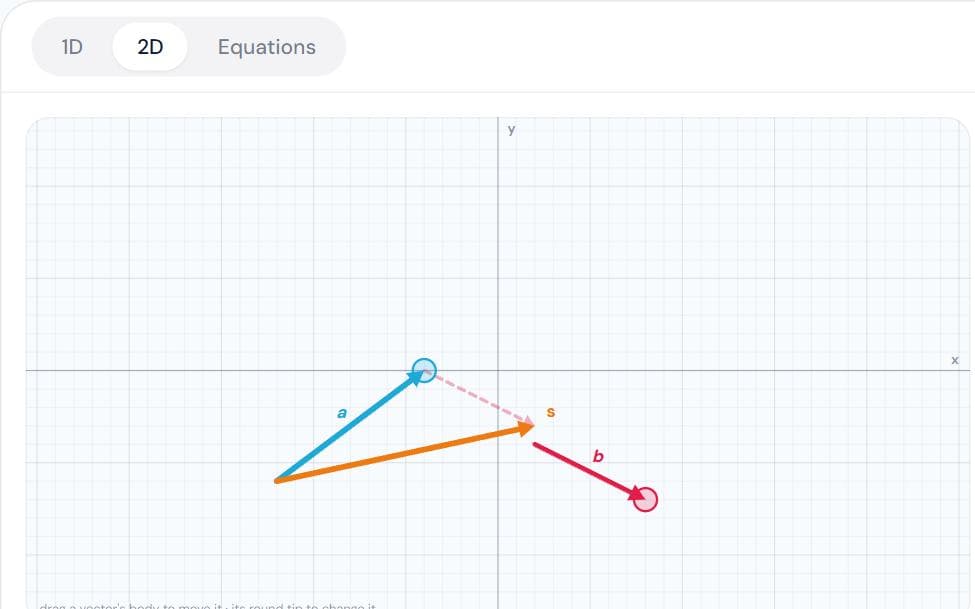
  1. 1Drag a vector's tail to move it and its tip to change it.
  2. 2Show components as projections or as a triangle.
  3. 3Toggle the sum, and A − B.
  4. 4Equations: scale A and B with the sliders.

What to notice

  • Add vectors tip to tail; the sum runs from the first tail to the last tip.
  • Components add like ordinary numbers: Rx = Ax + Bx.
  • A − B is A + (−B): flip B and add.
  • |A + B| is largest when they point the same way and smallest when opposite.

For teachers

A ready-made teaching kit comes with this lab

  • Lesson plan

    19 min, 4 steps

  • Ask the class

    3 questions with answers

  • Quick quiz

    6 questions, printable

  • Key formulas

    3 formulas

About the Vector Addition simulation

A vector has a size and a direction, so vectors cannot simply be added as numbers. Placed head to tail, the resultant runs from the first tail to the last head; equivalently, add their x-components and y-components separately. The order of addition does not matter.

In this vector addition simulation you drag vectors on a grid, read their magnitudes, angles and components, and see the sum drawn tip to tail. It fits Motion in a Plane (Class 11), Vector Algebra in Class 12 maths and JEE.

Also covers: vectors, components, resultant, triangle law, parallelogram law, polar, cartesian.
Frequently asked questions

What is the largest and smallest resultant of two vectors?

A + B when they point the same way, |A − B| when they point opposite ways.

Can two vectors add up to zero?

Only if they have equal magnitudes and opposite directions.

How do you add vectors using components?

Add all the x-components to get Rₓ and all the y-components to get R_y; then R = √(Rₓ² + R_y²).