Skip to content
Measurement & Vectors · Physics

Vernier Callipers Simulation

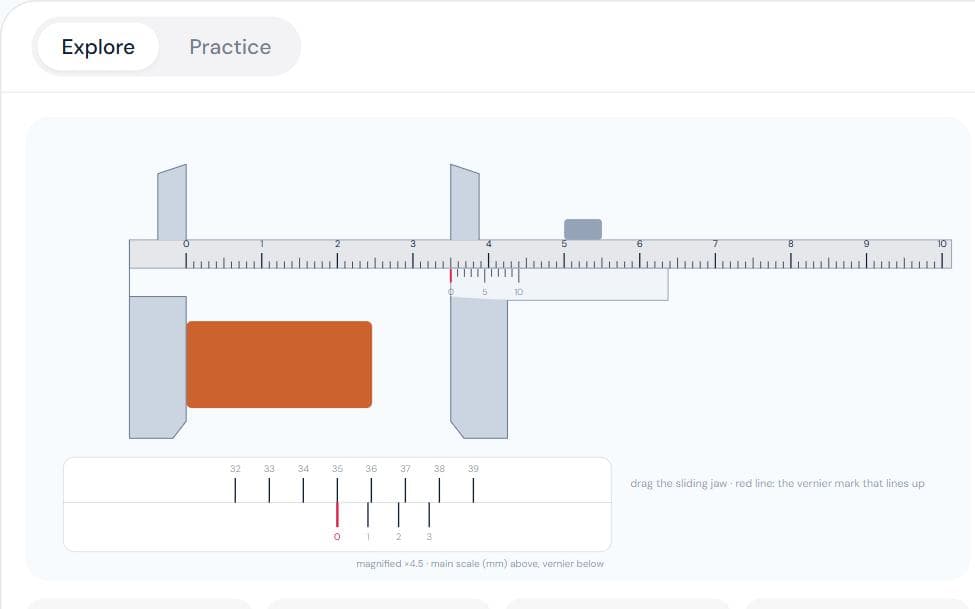
Slide the jaw of a vernier calliper to grip a cylinder, a sphere or a tube, read the main scale and the coinciding vernier division, and correct for zero error. Measure outside and inside diameters, then solve practice readings.

Interactive virtual lab · no download · works on phones and laptops

Chapter
Units and Measurements
For
Class 11 · JEE · NEET
Time
~12 min

Vernier Callipers is a Pro simulation

Pro opens all 125 virtual labs — 483 simulations with guides and quizzes.

How to use it

  1. 1Drag the sliding jaw (or use the arrows) until it touches the object.
  2. 2Find the vernier mark that lines up exactly with a main-scale mark.
  3. 3Change the number of vernier divisions and the zero error in the panel.
  4. 4Practice: read the callipers and type your answer.

What to notice

  • Least count = 1 MSD − 1 VSD = (value of 1 main-scale division) / (number of vernier divisions).
  • Reading = MSR + (coinciding vernier division × LC) − zero error.
  • If the vernier's zero is to the right of the main-scale zero with the jaws closed, the zero error is positive: subtract it.
  • Outside jaws measure outer diameter, inside jaws the inner diameter, and the strip at the end measures depth.

For teachers

A ready-made teaching kit comes with this lab

  • Lesson plan

    20 min, 4 steps

  • Ask the class

    4 questions with answers

  • Quick quiz

    6 questions, printable

  • Key formulas

    2 formulas

About the Vernier Callipers simulation

Vernier callipers measure lengths to a tenth (or a fiftieth) of a millimetre. A sliding vernier scale has n divisions that together equal n − 1 main-scale millimetres, so each vernier division is slightly shorter and exactly one of them lines up with a main-scale mark. Which one tells you the fraction of a millimetre: that is the least count at work.

In this vernier callipers simulation you slide the jaw to grip a cylinder, a sphere or a tube, choose 10, 20 or 50 vernier divisions, add a positive or negative zero error, and read the main scale and the coinciding division with a magnifier. Use the inside jaws for a tube's inner diameter, then test yourself in practice mode. It covers Units and Measurements in Class 11, the vernier practical, and the reading questions in JEE Main and NEET.

Also covers: vernier caliper, vernier callipers, least count, vernier constant, zero error, main scale reading, vernier scale, internal diameter, depth, units and measurement.
Frequently asked questions

What is the least count of a vernier calliper with 10 divisions?

0.1 mm: 10 vernier divisions equal 9 mm, so each is 0.9 mm and LC = 1 − 0.9 = 0.1 mm.

How do you find the zero error of vernier callipers?

Close the jaws. If the vernier's zero is to the right of the main-scale zero, the error is positive (count the coinciding division × LC); if to the left, negative. Subtract it, with its sign, from every reading.

Which jaws measure the inner diameter of a tube?

The small upper (inside) jaws, which open against the walls of the bore.

Which is more precise, vernier callipers or a screw gauge?

A screw gauge (LC 0.01 mm) is ten times finer than an ordinary vernier (LC 0.1 mm), so it is used for wires and thin sheets.