Skip to content
Mechanics · Physics

Vertical Motion Under Gravity Simulation

Throw a ball straight up and follow its height, velocity and acceleration all the way back down. Strobe dots show the symmetry of the flight; with two balls, drop one and throw the other and find where they pass.

Interactive virtual lab · no download · works on phones and laptops

Chapter
Kinematics
For
Class 9 · Class 11 · JEE · NEET
Time
~10 min

Vertical Motion Under Gravity is a Pro simulation

Pro opens all 125 virtual labs — 483 simulations with guides and quizzes.

How to use it

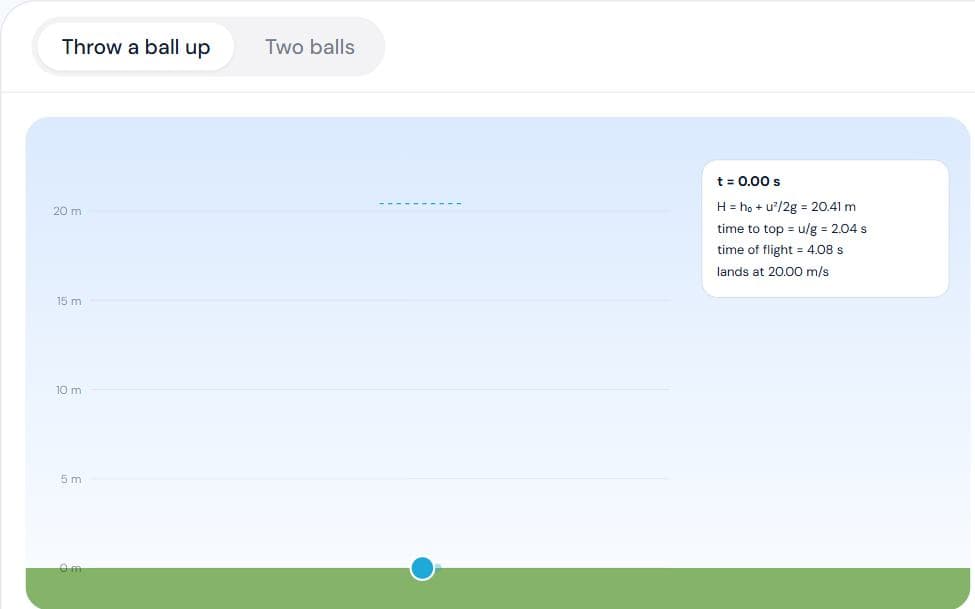
  1. 1Throw a ball up: set u and the launch height, then play.
  2. 2Two balls: pick a situation or set heights, speeds and release times.

What to notice

  • With up as +, a = −9.8 m/s² the whole time, even at the top where v = 0.
  • H = u²/2g, time to the top u/g, back to the start after 2u/g.
  • It passes each height at the same speed going up and coming down.
  • Two balls in flight have no relative acceleration, so they close at a constant speed.

For teachers

A ready-made teaching kit comes with this lab

  • Lesson plan

    18 min, 4 steps

  • Ask the class

    3 questions with answers

  • Quick quiz

    5 questions, printable

  • Key formulas

    3 formulas

About the Vertical Motion Under Gravity simulation

A ball thrown straight up slows down at 9.8 m/s² every second, stops for an instant at the top, and speeds up at the same rate coming down. With upwards taken as positive the acceleration is −g the whole time, including at the top. Without air resistance the flight is symmetric: it passes every height at the same speed on the way up and on the way down.

This vertical motion simulation throws a ball up from any height and plots height, velocity and acceleration against time, with strobe dots every quarter second to show the symmetry. In the two-ball mode you can drop one ball and throw another, from different heights and at different times, and find where they pass each other. Both feel the same g, so relative to each other they move at a constant velocity.

Also covers: ball thrown upward, free fall, maximum height, time of flight, time to reach the top, motion under gravity, two balls meet, dropped and thrown, acceleration due to gravity.
Frequently asked questions

What is the acceleration of a ball at its highest point?

Still g = 9.8 m/s² downwards. Its velocity is zero there for an instant, but gravity has not stopped acting.

Is the time to go up equal to the time to come down?

Yes, back to the same height and without air resistance. Each is u/g, so the whole flight from and to the launch point takes 2u/g.

When do a dropped ball and a ball thrown up meet?

When the gap between them is used up at their closing speed. If one is dropped from height h as the other is thrown up at u, they meet after h/u seconds, provided both are still in the air.