Skip to content
Mechanics · Physics

Work, Energy & Power Simulation Lab

Twenty-four experiments from "what counts as work" to JEE Advanced: work and its sign, kinetic and potential energy, force–position graphs, power and efficiency, springs, conservative forces, potential-energy curves and equilibrium, friction, pulleys and system boundaries, the vertical loop, a 3D rocket, two blocks and a spring, release protocols, collisions, machines, spring networks, moving surfaces, a 3D saddle, a trap detector and a challenge arena. All 121 questions of Edukul's work–energy question bank are built in, each with a "Show me".

Interactive virtual lab · no download · works on phones and laptops

Chapter
Work, Energy & Power
For
Class 6–12 · JEE
Time
~40 min

Work, Energy & Power Lab is a Pro simulation

Pro opens all 125 virtual labs — 483 simulations with guides and quizzes.

How to use it

  1. 1Pick a module from the list (24, grouped); set your level at the top right to show more controls.
  2. 2Drag on the stage, or use the sliders and type exact values.
  3. 3Use Predict before pressing play, then Derive, Questions (with hints and Show me), Practise and Compare.
  4. 4Save two trials in Compare to see what one change did.

What to notice

  • Work needs displacement of the force's point of action: W = Fs cos θ, zero at 90°.
  • W_net = ΔK for any forces, constant or not; no time needed.
  • Gravity's work depends only on the endpoints; friction's on the route.
  • Force is −dU/dx: equilibria are flat points of U, stable at minima.
  • Choose the system first: internal forces' works (an ideal string's tension) cancel.
  • Only the relative-motion energy ½μu² can go into a spring between two moving blocks.

For teachers

A ready-made teaching kit comes with this lab

  • Lesson plan

    38 min, 4 steps

  • Ask the class

    4 questions with answers

  • Quick quiz

    7 questions, printable

  • Key formulas

    7 formulas

About the Work, Energy & Power Lab simulation

Work, energy and power is the chapter where a single idea — energy is transferred by forces acting through displacements — replaces pages of kinematics. This lab builds that idea in twenty-four experiments, from "is pushing a wall work?" for Class 6–8 to the reduced-mass spring problem, release protocols and multidirectional stability for JEE Advanced.

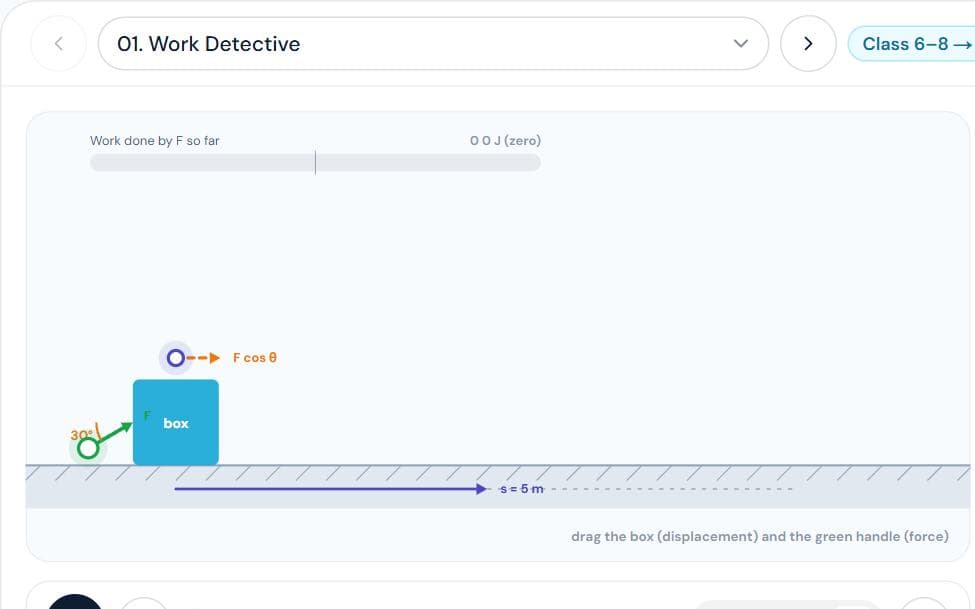
Every experiment is a live simulation: drag the box, turn the force dial, draw your own force–position graph or route, launch a block across rough zones, send a bead round a vertical loop, fire a rocket in 3D, or roll a ball on a saddle-shaped potential surface. Each one shows its equations with your numbers in them, an energy ledger with a residual check, and graphs linked to the clock. Predict before you run, derive the result step by step, then answer the built-in questions — all 121 questions of Edukul's work, energy and power question bank, each with hints and a "Show me" that sets up the experiment.

Also covers: work done, work energy theorem, kinetic energy, potential energy, reference level, force position graph, area under force graph, power, efficiency, kilowatt hour, spring potential energy, hooke's law, conservative force, non conservative force, potential energy curve, stable unstable neutral equilibrium, stopping distance, vertical circle, loop the loop, rocket, maximum compression, reduced mass, collisions, coefficient of restitution, springs in series and parallel, work by normal force, conveyor belt, hc verma work energy.
Frequently asked questions

Is work done when you push a wall that does not move?

No work is done on the wall: its displacement is zero, so W = F × 0 = 0. Your muscles still use chemical energy, which is why you get tired.

Can the normal force do work?

Yes, when the surface moves. A lift floor pushing a passenger upward through a distance d does work m(g + a)d on them. On a fixed surface the normal force is perpendicular to the motion and does none.

Why is the stopping distance four times larger at twice the speed?

Friction removes μmg joules per metre, and the kinetic energy to remove is ½mu². So d = u²/(2μg): double u, quadruple d.

Do both blocks stop at maximum compression of the spring between them?

Not in general. At maximum compression their relative velocity is zero, so both move with the centre-of-mass velocity, which is only zero if the total momentum is zero.