Skip to content
Organic Reactions · Chemistry

E1 & E2 Elimination Reactions Simulation

Watch a base pull off a β-hydrogen as bromide leaves and a C=C forms, with three curved arrows in one step. Turn the C–C bond until H and Br are anti-periplanar, compare Zaitsev and Hofmann products, and follow E1 through its carbocation.

Interactive virtual lab · no download · works on phones and laptops

Chapter
Haloalkanes & Haloarenes
For
Class 12 · JEE · NEET
Time
~15 min

How to use it

  1. 1E2: set the dihedral to 180° in the Newman view, then step through.
  2. 2Try another dihedral: E2 will not start until the H and Br line up.
  3. 3Zaitsev or Hofmann: switch between ethoxide and tert-butoxide.
  4. 4E1: step through ionisation, the carbocation and loss of a β-H.

What to notice

  • E2 is one step: base → H, C–H → C=C, C–Br → Br, all together; rate = k[RX][B⁻].
  • E2 needs the β-H and the leaving group anti-periplanar (180° apart).
  • A small base gives mainly the more substituted (Zaitsev) alkene; a bulky one the less substituted (Hofmann).
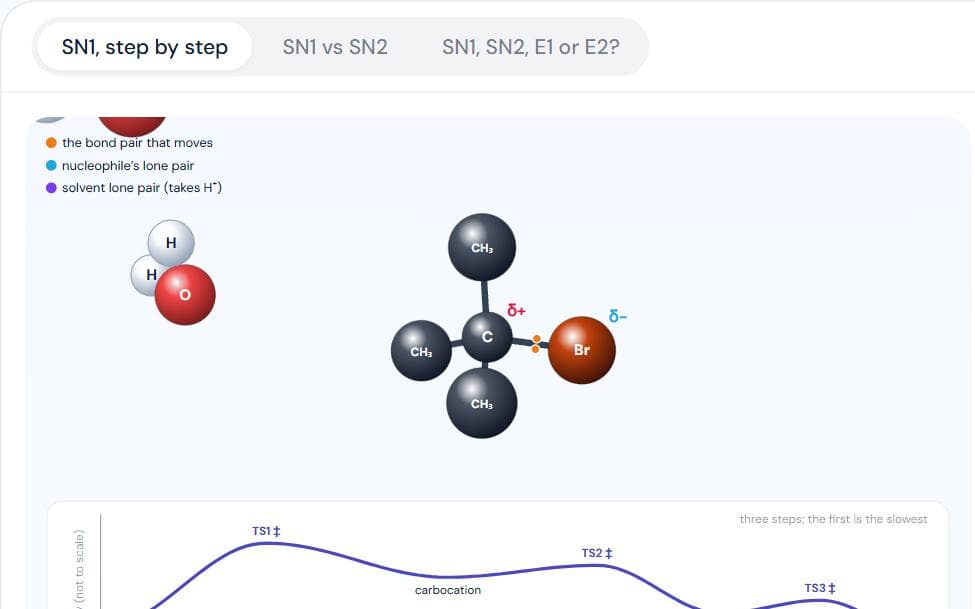
  • E1 ionises first, like SN1, then a weak base removes a β-H; heat favours it.

For teachers

Teach it in 21 minutes

A lesson plan, questions to put to the class, a quick quiz you can project or print, and the formulas behind E1 & E2 Elimination Reactions.

  1. 1Hook

    ~2 min
    • Ask: “Bromide leaves and a C=C forms. Which hydrogen goes, and does it matter where it sits?” Then turn the Newman projection.
  2. 2Demonstrate

    ~9 min
    • E2: set the dihedral to 180° in the Newman view, then step through.
    • Try another dihedral: E2 will not start until the H and Br line up.
    • Zaitsev or Hofmann: switch between ethoxide and tert-butoxide.
    • E1: step through ionisation, the carbocation and loss of a β-H.
  3. 3Pause and ask

    ~5 min
    • Have a student say this in their own words: E2 is one step: base → H, C–H → C=C, C–Br → Br, all together; rate = k[RX][B⁻].
    • Have a student say this in their own words: E2 needs the β-H and the leaving group anti-periplanar (180° apart).
    • Have a student say this in their own words: A small base gives mainly the more substituted (Zaitsev) alkene; a bulky one the less substituted (Hofmann).
    • Have a student say this in their own words: E1 ionises first, like SN1, then a weak base removes a β-H; heat favours it.
  4. 4Check

    ~5 min
    • Run the 5-question quiz below: project it and take answers by show of fingers (1–4), or print it as a worksheet.

About the E1 & E2 Elimination Reactions simulation

In an elimination reaction a hydrogen on the carbon next to the halogen (a β-hydrogen) and the halogen itself are removed, and a C=C double bond forms between the two carbons. In E2 a strong base takes the β-hydrogen while the halide leaves, in one concerted step, so rate = k[RX][base]. It needs the β-H and the leaving group anti-periplanar, 180° apart, so that the C–H bond's electrons can flow into the new π bond. E1 goes through a carbocation first, like SN1, and a weak base then removes a β-hydrogen.

This E1 and E2 elimination simulation shows both mechanisms step by step on a 3D model, with the three electron pairs of E2 colour-coded and a Newman projection you turn until H and Br are anti-periplanar — E2 will not start until they are. A Zaitsev or Hofmann view compares the products from 2-bromo-2-methylbutane with a small base (ethoxide) and a bulky one (tert-butoxide), and the E1 tab follows the ionisation, the carbocation and the loss of a β-hydrogen.

Also covers: e2, e1, elimination, beta elimination, dehydrohalogenation, anti periplanar, newman projection, zaitsev rule, saytzeff, hofmann product, bulky base, alkene formation.
Frequently asked questions

Why must E2 be anti-periplanar?

With the β-H and the leaving group 180° apart in one plane, the C–H bonding orbital lines up with the C–X antibonding orbital, so the two can turn smoothly into the new π bond in a single step.

What is Zaitsev's rule?

In elimination the more substituted alkene, with more alkyl groups on the double-bond carbons, is usually the major product because it is more stable.

Why does a bulky base give the Hofmann product?

A large base such as tert-butoxide cannot easily reach the crowded internal β-hydrogens, so it removes a hydrogen from the more exposed CH₃ group and the less substituted alkene forms.

What is the difference between E1 and E2?

E2 is one step with a strong base and is second order; E1 is two steps through a carbocation, with a weak base, and is first order. E1 can rearrange; E2 cannot.