Skip to content
Organic Reactions · Chemistry

SN1 Reaction Mechanism Simulation

Watch tert-butyl bromide ionise to a flat carbocation, then a solvent molecule attack it from either face. See why SN1 is first order and racemises, set it beside SN2, and decide SN1, SN2, E1 or E2 for real cases.

Interactive virtual lab · no download · works on phones and laptops

Chapter
Haloalkanes & Haloarenes
For
Class 12 · JEE · NEET
Time
~15 min

How to use it

  1. 1SN1, step by step: press Next step and answer each prediction first.
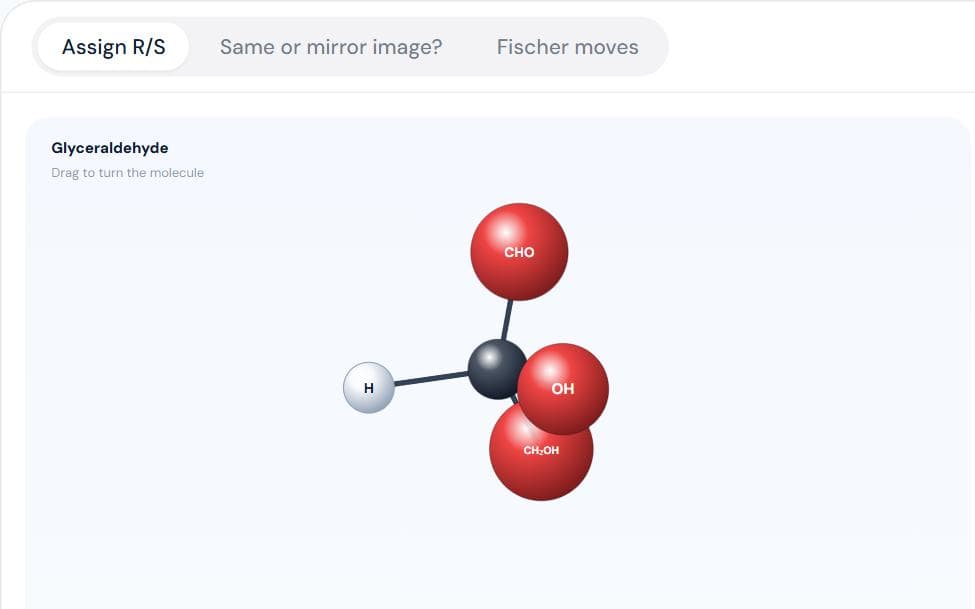
  2. 2Pick the chiral substrate, choose the face of attack, and watch the R/S label.
  3. 3React 10 molecules to see the racemic mixture build up.
  4. 4SN1 vs SN2: move [Nu] and see which rate changes.
  5. 5SN1, SN2, E1 or E2?: decide the major pathway for twelve textbook cases.

What to notice

  • The slow step is the C–Br bond breaking on its own: rate = k[RX].
  • The carbocation is planar with an empty p orbital: an intermediate in an energy valley.
  • Attack from either face gives both R and S: a chiral substrate racemises.
  • Carbocation stability, 3° > 2° > 1° > CH₃⁺, makes SN1 the reverse of the SN2 order.
  • Water or an alcohol first gives an oxonium ion, which loses H⁺.

For teachers

Teach it in 21 minutes

A lesson plan, questions to put to the class, a quick quiz you can project or print, and the formulas behind SN1 Reaction Mechanism.

  1. 1Hook

    ~2 min
    • Show (CH₃)₃C–Br in water and ask: “Does the water attack first, or does something have to break first?” Step through and check.
  2. 2Demonstrate

    ~9 min
    • SN1, step by step: press Next step and answer each prediction first.
    • Pick the chiral substrate, choose the face of attack, and watch the R/S label.
    • React 10 molecules to see the racemic mixture build up.
    • SN1 vs SN2: move [Nu] and see which rate changes.
    • SN1, SN2, E1 or E2?: decide the major pathway for twelve textbook cases.
  3. 3Pause and ask

    ~5 min
    • Have a student say this in their own words: The slow step is the C–Br bond breaking on its own: rate = k[RX].
    • Have a student say this in their own words: The carbocation is planar with an empty p orbital: an intermediate in an energy valley.
    • Have a student say this in their own words: Attack from either face gives both R and S: a chiral substrate racemises.
    • Have a student say this in their own words: Carbocation stability, 3° > 2° > 1° > CH₃⁺, makes SN1 the reverse of the SN2 order.
    • Have a student say this in their own words: Water or an alcohol first gives an oxonium ion, which loses H⁺.
  4. 4Check

    ~5 min
    • Run the 5-question quiz below: project it and take answers by show of fingers (1–4), or print it as a worksheet.

About the SN1 Reaction Mechanism simulation

SN1 means substitution, nucleophilic, unimolecular. It happens in steps: first the carbon–halogen bond breaks on its own, giving a flat carbocation and a halide ion; then a nucleophile — often the solvent, water or an alcohol — bonds to the cation; with water or an alcohol a proton is lost last. The first step is slow and decides the rate, and the nucleophile is not in it, so rate = k[RX]. Tertiary halides react this way because their carbocations are the most stable.

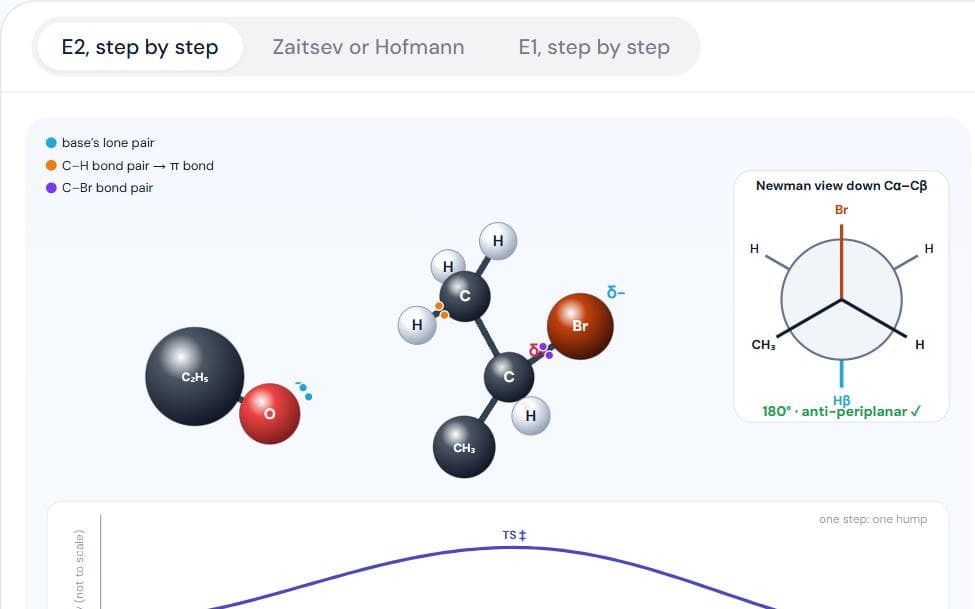
This SN1 reaction simulation plays the mechanism step by step on a 3D model, with the moving electron pairs and curved arrows drawn and a prediction before each step. With a chiral substrate it shows the R/S label from the model itself: attack on one face of the cation gives one configuration, the other face the mirror image, and reacting many molecules builds a racemic mixture. A second tab sets SN1 beside SN2, and a third asks you to choose SN1, SN2, E1 or E2 for real reaction conditions.

Also covers: sn1, unimolecular substitution, carbocation, racemisation, racemization, solvolysis, rate determining step, sn1 vs sn2, tertiary alkyl halide, carbocation stability, which mechanism sn1 sn2 e1 e2.
Frequently asked questions

Why does SN1 give a racemic mixture?

The carbocation is planar, and its empty p orbital has two equal lobes, so the nucleophile attacks either face about equally often. One face gives the R product, the other the S product.

Why do tertiary alkyl halides react by SN1?

Three alkyl groups stabilise the positive charge of the carbocation by their +I effect and hyperconjugation, so it forms quickly; they also block the backside attack that SN2 needs.

Why is the rate of SN1 independent of the nucleophile?

The nucleophile joins only after the slow step, the ionisation of RX. Changing its concentration does not change how fast the carbocation forms.

Which solvent favours SN1?

A polar protic solvent such as water or an alcohol. It stabilises both the carbocation and the leaving halide ion by solvation, and often acts as the nucleophile too (solvolysis).