Skip to content
Heat & Matter · Physics

Energy Forms & Changes Simulation

Heat and cool blocks of iron and brick and beakers of water and oil, and watch energy flow from hot to cold. Then build a system — sun, tap or kettle → generator or panel → bulb or heater.

Interactive virtual lab · no download · works on phones and laptops

Chapter
Work and Energy · Thermal Properties
For
Class 7 · Class 9
Time
~12 min

Energy Forms & Changes is a Pro simulation

Pro opens all 125 virtual labs — 483 simulations with guides and quizzes.

How to use it

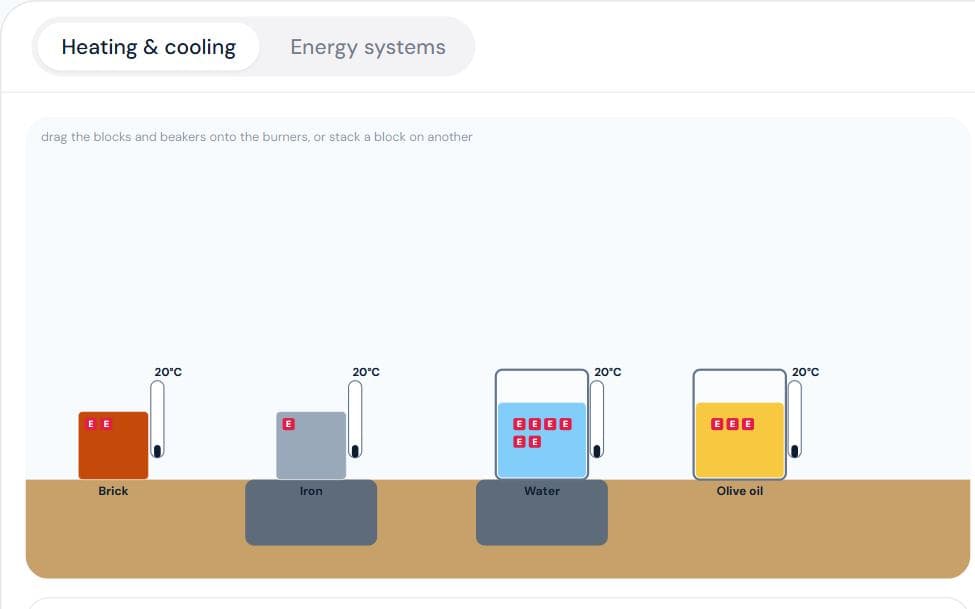
  1. 1Intro: drag blocks onto the burners and heat or cool them.
  2. 2Stack blocks or put them in a beaker to see heat flow between them.
  3. 3Systems: choose a source, a converter and a user.
  4. 4Turn on energy symbols to watch each chunk travel.

What to notice

  • Heat flows from hotter to colder objects until they reach the same temperature.
  • Different materials need different energy to warm by one degree.
  • Energy changes form but is never lost; some always ends up as heat.

For teachers

A ready-made teaching kit comes with this lab

  • Lesson plan

    20 min, 4 steps

  • Ask the class

    3 questions with answers

  • Quick quiz

    6 questions, printable

  • Key formulas

    2 formulas

About the Energy Forms & Changes simulation

Energy is never made or destroyed, only changed from one form to another — and some of it always ends up as thermal energy. Heating a block raises the temperature of its particles; heat flows from hot to cold until everything reaches the same temperature, and different materials need very different amounts of energy to warm up.

In this energy forms and changes simulation you heat and cool iron, brick, water and olive oil on burners and watch energy flow between them. A second screen builds an energy system: the Sun, a tap, a kettle or a cyclist drives a generator or solar panel that lights a bulb, heats water or spins a fan, with energy chunks showing every change of form. It suits Work and Energy in Class 9 and Thermal Properties of Matter in Class 11.

Also covers: energy transfer, heat flow, thermal equilibrium, energy conversion, solar panel, generator.
Frequently asked questions

Why does water take longer to heat than iron?

Water's specific heat capacity (about 4200 J/kg K) is much higher than iron's (about 450 J/kg K), so each degree needs far more energy.

Is energy lost when a bulb lights up?

Not lost — some becomes light (useful) and the rest thermal energy (wasted). The total stays the same.

Why is an LED bulb more efficient than a filament bulb?

It turns more of its electrical energy into light and less into heat.