Skip to content
Waves & Sound · Physics

Fourier Series Simulation: Making Waves

Add sine waves of different harmonics and watch them build a square, sawtooth or triangle wave. Hear the sound change, then play the wave-matching game.

Interactive virtual lab · no download · works on phones and laptops

Chapter
Waves
For
Class 11 · Olympiad
Time
~12 min

Fourier: Making Waves is a Pro simulation

Pro opens all 125 virtual labs — 483 simulations with guides and quizzes.

How to use it

  1. 1Drag each harmonic's amplitude bar.
  2. 2Pick a preset waveform and change how many harmonics it uses.
  3. 3Press Listen to hear the sum.
  4. 4Game: match the target wave's amplitudes.

What to notice

  • Any periodic wave is a sum of sines at whole-number multiples of one frequency.
  • A square wave uses only odd harmonics, with amplitudes 1, 1/3, 1/5 …
  • More harmonics → sharper corners, but a small overshoot remains.
  • Timbre — how an instrument sounds — is its mix of harmonics.

For teachers

A ready-made teaching kit comes with this lab

  • Lesson plan

    20 min, 4 steps

  • Ask the class

    3 questions with answers

  • Quick quiz

    6 questions, printable

  • Key formulas

    3 formulas

About the Fourier: Making Waves simulation

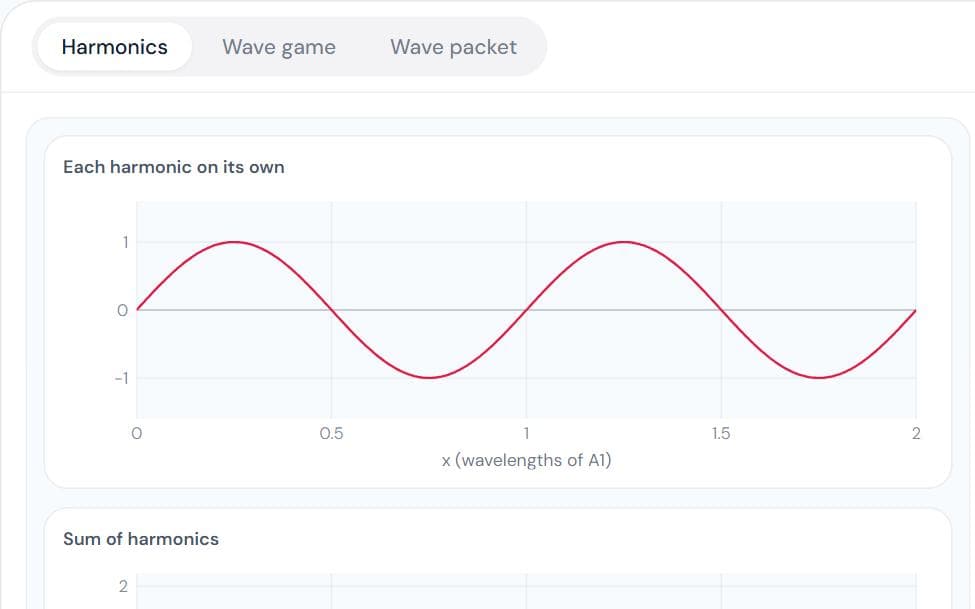
Fourier's idea is that any repeating wave — a square wave, a sawtooth, even the sound of a violin — can be built by adding sine waves whose frequencies are whole-number multiples of the first. The amplitudes of those harmonics are the wave's recipe; change them and you change its shape and its sound.

In this Fourier simulation you add harmonics one at a time with sliders to build sine, square, triangle and sawtooth waves, hear the result, play a matching game against a target waveform, and build a wave packet to see why a short pulse needs a wide spread of wavelengths. It goes beyond the Class 11 Waves chapter into Olympiad-level ideas.

Also covers: harmonics, fourier series, square wave, sawtooth, superposition, wave packet.
Frequently asked questions

Which harmonics make a square wave?

Only the odd ones: 1, 3, 5, 7…, with amplitudes 1, 1/3, 1/5, 1/7…

Why does a square wave built from sines have overshoots at the corners?

That is the Gibbs phenomenon: a finite number of harmonics always overshoots a sudden jump by about 9%.

Why does a short pulse need many frequencies?

A narrow packet in space needs a wide spread of wavenumbers — the narrower the pulse, the wider the spread (σₓ · σₖ = 1).