Skip to content
Heat & Matter · Physics

Friction Simulation

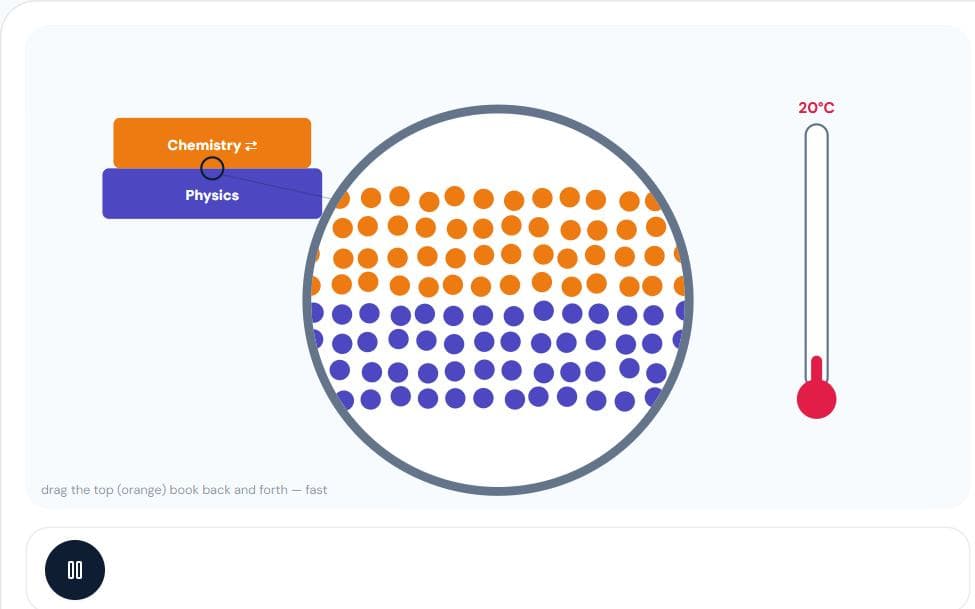
Rub one book over another and zoom into the surfaces. The atoms jiggle faster as they heat up — rub hard enough and some break away.

Interactive virtual lab · no download · works on phones and laptops

Chapter
Friction · Laws of Motion
For
Class 8 · Class 11
Time
~6 min

Friction is a Pro simulation

Pro opens all 125 virtual labs — 483 simulations with guides and quizzes.

How to use it

  1. 1Drag the top book left and right across the bottom one.
  2. 2Watch the magnifier and the thermometer.
  3. 3Leave it still to let it cool.

What to notice

  • Friction comes from atoms of the two surfaces snagging on each other.
  • Rubbing makes the atoms vibrate faster: the surfaces warm up.
  • Hot atoms at the surface can break loose — that is wear.
  • Left alone, the surfaces cool as energy spreads out.

For teachers

A ready-made teaching kit comes with this lab

  • Lesson plan

    17 min, 4 steps

  • Ask the class

    3 questions with answers

  • Quick quiz

    6 questions, printable

  • Key formulas

    1 formulas

About the Friction simulation

Friction comes from the roughness of surfaces at the atomic scale: when two surfaces slide, their atoms catch and pull on each other. The work done against friction doesn't vanish — it makes the atoms jiggle faster, which is heat, and if they get hot enough some break away altogether, which is wear.

This friction simulation zooms in to the atoms of two books. Rub the top one along the bottom and watch the surface temperature rise and atoms break loose; stop, and the surfaces cool back down. It suits Friction in Class 8 and Laws of Motion in Class 11.

Also covers: friction heat, molecular model, thermal energy, surface atoms, wear.

Frequently asked questions

Why do your hands warm up when you rub them together?

The work done against friction becomes thermal energy — the atoms of your skin vibrate faster.

Why do surfaces wear away with use?

Sliding heats and stresses the surface atoms until some break their bonds and come away.

Does friction always oppose motion?

It opposes the relative sliding of the two surfaces in contact.