Skip to content
Heat & Matter · Physics

Gas Properties Simulation

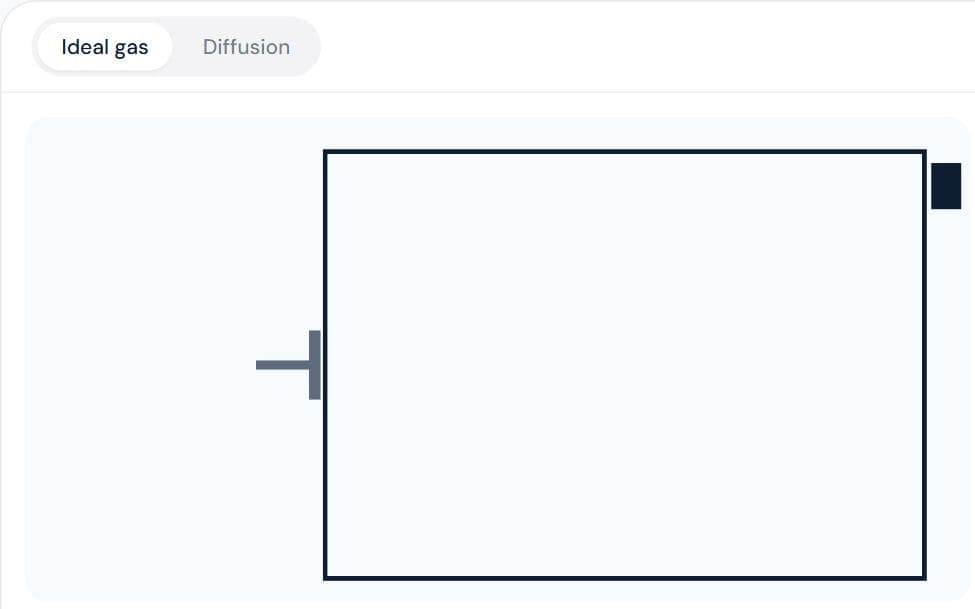
Pump molecules into a box and push the wall, heat it, or cool it. Watch pressure, volume and temperature follow PV = NkT — and the speed histogram spread as the gas warms.

Interactive virtual lab · no download · works on phones and laptops

Chapter
Kinetic Theory · Thermodynamics
For
Class 11 · JEE · NEET
Time
~15 min

Gas Properties is a Pro simulation

Pro opens all 125 virtual labs — 483 simulations with guides and quizzes.

How to use it

  1. 1Pump heavy or light molecules into the box.
  2. 2Drag the left wall to change the volume.
  3. 3Heat or cool with the slider under the box.
  4. 4Hold one quantity constant and watch the others.
  5. 5Diffusion: remove the divider between two gases.

What to notice

  • Pressure comes from molecules hitting the walls.
  • At constant temperature, halving the volume doubles the pressure (Boyle).
  • Temperature measures the average kinetic energy of the molecules.
  • Light molecules move faster than heavy ones at the same temperature.

For teachers

A ready-made teaching kit comes with this lab

  • Lesson plan

    23 min, 4 steps

  • Ask the class

    3 questions with answers

  • Quick quiz

    7 questions, printable

  • Key formulas

    3 formulas

About the Gas Properties simulation

A gas is a crowd of tiny particles flying about and bouncing off the walls; its pressure is the push of those collisions. Heat it and the particles move faster, so pressure rises unless the volume grows. Pressure, volume, temperature and the number of particles are linked by the ideal gas law, and the speeds of the particles follow the Maxwell distribution.

In this gas properties simulation you pump heavy or light particles into a box, heat or cool it, push the wall in, hold volume, pressure or temperature constant, and read the pressure and a speed histogram. A diffusion screen lets two gases mix through a gap. It covers Kinetic Theory and Thermodynamics in Class 11, JEE and NEET, and gases in chemistry.

Also covers: ideal gas law, pv=nrt, boyle's law, charles law, kinetic theory, pressure, diffusion, gases intro, maxwell distribution.
Frequently asked questions

Why does pressure rise when a gas is heated in a fixed box?

The particles move faster, so they hit the walls harder and more often.

Do heavy and light particles at the same temperature have the same speed?

No — the same average kinetic energy. The lighter ones move faster (v_rms ∝ 1/√m).

What happens to pressure if volume halves at constant temperature?

It doubles (Boyle's law).