Skip to content
Heat & Matter · Physics

Heat Transfer Simulation

Three benches: a bar between two baths solved with the heat equation (copper settles in minutes, oak in days; remove the lagging and the profile sags), a fluid layer heated from below that stays still until the Rayleigh number passes 1708, and plates facing a lamp that warm according to distance, absorptivity and emissivity.

Interactive virtual lab · no download · works on phones and laptops

Chapter
Thermal Properties of Matter
For
Class 7–11 · JEE · NEET
Time
~20 min

Heat Transfer is a Pro simulation

Pro opens all 125 virtual labs — 483 simulations with guides and quizzes.

How to use it

  1. 1Pick a bench at the top.
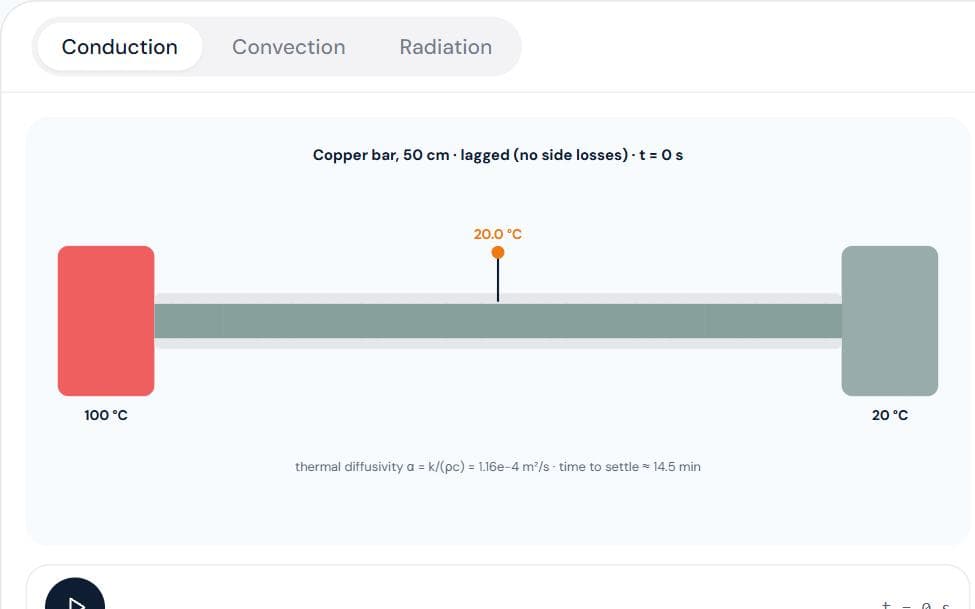
  2. 2Conduction: choose the material, press play, drag the probe; toggle the lagging.
  3. 3Convection: raise ΔT or the depth until the rolls appear; switch gravity off.
  4. 4Radiation: move the plates and change their surfaces.

What to notice

  • All lagged bars end on the same straight profile; the time to get there scales as L²/α.
  • Convection starts only above a critical Rayleigh number; without gravity there is none.
  • Radiation falls as 1/d²; a plate settles where absorbed and emitted power balance.
  • White paint stays cool under a lamp, polished metal runs hot.

For teachers

A ready-made teaching kit comes with this lab

  • Lesson plan

    24 min, 4 steps

  • Ask the class

    3 questions with answers

  • Quick quiz

    5 questions, printable

  • Key formulas

    4 formulas

About the Heat Transfer simulation

Heat moves in three ways, and this simulation gives each its own bench. Conduction: a metal bar runs between a hot and a cold bath, and the temperature along it is computed from the heat equation, so you can watch the profile bend towards a straight line. Copper gets there in minutes; oak would take days, because the time scale is the length squared divided by the thermal diffusivity. Take the lagging off and the bar loses heat from its sides, so the steady profile sags into a cosh curve.

Convection: a fluid layer heated from below stays perfectly still until the Rayleigh number — buoyancy against viscosity and thermal diffusion — passes 1708; then convection rolls form and the Nusselt number, the heat carried relative to conduction alone, climbs. Switch gravity off and nothing moves. Radiation: two plates face a hot lamp; the irradiance falls with the square of the distance, and each plate settles where what it absorbs equals what it radiates. Surfaces matter: white paint stays cool, polished metal runs hot.

Also covers: heat transfer, conduction, convection, radiation, thermal conductivity, fourier's law, heat equation, lagging, rayleigh number, nusselt number, convection rolls, stefan boltzmann, inverse square law radiation, absorptivity, emissivity, white paint black paint.

Frequently asked questions

Why does copper reach a steady temperature profile faster than wood?

The time to settle scales as L²/α, where α = k/(ρc) is the thermal diffusivity. Copper's α is about a thousand times oak's, so it settles a thousand times faster — but both end on the same straight line when lagged.

Why does convection need gravity?

Convection is driven by buoyancy: warm fluid is less dense and rises only because gravity pulls the denser fluid down. In orbit there is no buoyancy, which is why spacecraft need fans.

Why does a white surface stay cooler in sunlight than a black one?

White paint absorbs little visible light (low absorptivity for the Sun's spectrum) but still radiates well in the infrared (high emissivity), so its balance temperature is low. Black paint absorbs most of the light.