Skip to content
Waves & Sound · Physics

Normal Modes Simulation

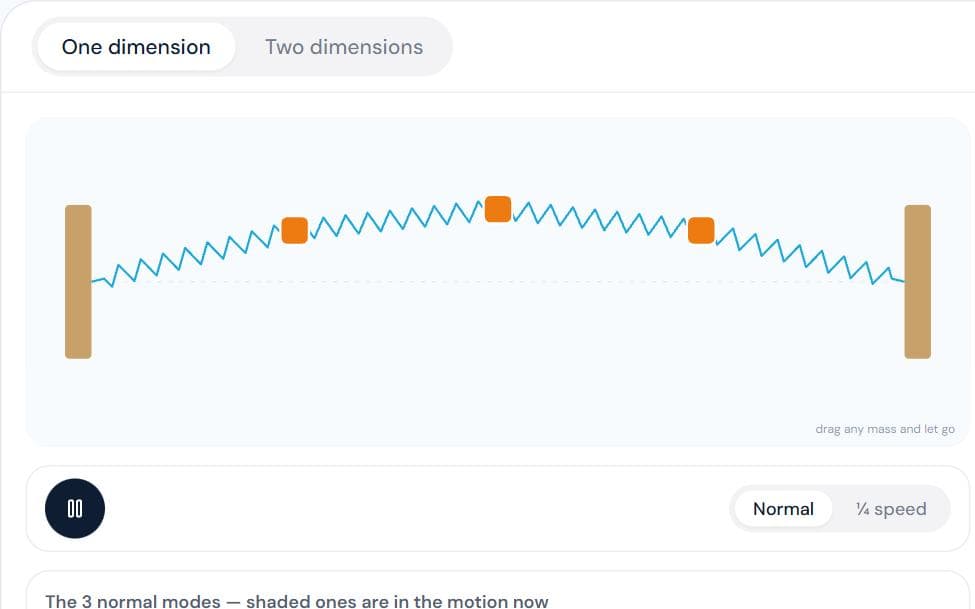
A row of masses joined by springs. Pull one and the motion looks messy — but it is a sum of normal modes, each a standing wave with its own frequency.

Interactive virtual lab · no download · works on phones and laptops

Chapter
Oscillations · Waves
For
Class 11 · Olympiad
Time
~12 min

Normal Modes is a Pro simulation

Pro opens all 125 virtual labs — 483 simulations with guides and quizzes.

How to use it

  1. 1Choose the number of masses.
  2. 2Drag a mass to displace it, then release.
  3. 3Or set mode amplitudes with the sliders to excite one mode cleanly.
  4. 4Switch between longitudinal and transverse motion.

What to notice

  • N masses have N normal modes, each with a fixed shape and frequency.
  • In mode n the frequency is ωₙ = 2ω₀ sin(nπ / 2(N+1)).
  • Any motion is a combination of the normal modes.
  • A single mode keeps its shape forever; a mixture changes shape.

For teachers

A ready-made teaching kit comes with this lab

  • Lesson plan

    20 min, 4 steps

  • Ask the class

    3 questions with answers

  • Quick quiz

    6 questions, printable

  • Key formulas

    2 formulas

About the Normal Modes simulation

A row of masses joined by springs can vibrate in special patterns called normal modes, in which every mass moves at the same frequency. Any motion of the system, however messy, is a mixture of these modes. A chain of N masses has N modes, from the slow one where all move together to the fast one where neighbours move opposite ways.

In this normal modes simulation you choose the number of masses in one dimension or a grid in two, set the amplitude and phase of each mode, and see transverse or longitudinal motion. It connects Oscillations and Waves in Class 11 to the standing waves on strings and in pipes, and to Olympiad problems.

Also covers: coupled oscillators, masses and springs chain, standing waves, mode shapes.

Frequently asked questions

How many normal modes do N coupled masses have?

N in one direction of motion — one for each mass.

What is special about a normal mode?

Every part of the system oscillates at the same frequency and keeps a fixed phase relation, so the pattern repeats exactly.

How are normal modes related to standing waves?

A string is the limit of very many masses; its harmonics are the normal modes of that continuous chain.