Skip to content
Waves & Sound · Physics

Sound Waves Simulation

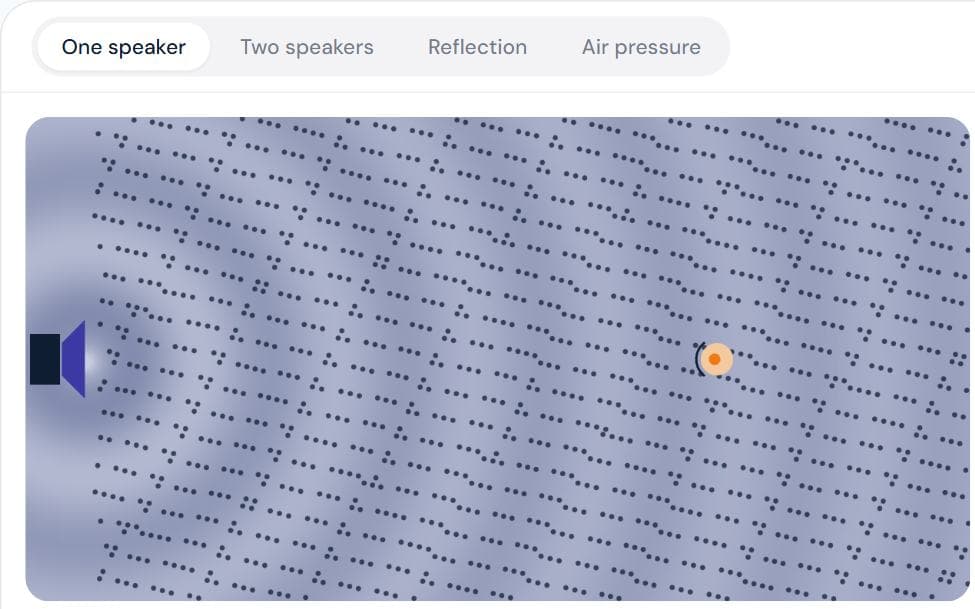
A speaker pushes air molecules back and forth. See compressions and rarefactions travel, change pitch and loudness, listen to it, and pump the air out to watch sound die.

Interactive virtual lab · no download · works on phones and laptops

Chapter
Sound · Waves
For
Class 9 · Class 11
Time
~10 min

Sound Waves is a Pro simulation

Pro opens all 125 virtual labs — 483 simulations with guides and quizzes.

How to use it

  1. 1Set frequency and amplitude; press Listen to hear it.
  2. 2Switch between particle and pressure views.
  3. 3Move the listener; add a reflecting wall.
  4. 4Air pressure tab: pump air out of the box.

What to notice

  • Sound is longitudinal: air moves back and forth along the direction of travel.
  • Higher frequency → shorter wavelength, at the same speed (v = fλ).
  • Larger amplitude → louder sound; it does not change the pitch.
  • No air, no sound: it needs a medium.

For teachers

A ready-made teaching kit comes with this lab

  • Lesson plan

    19 min, 4 steps

  • Ask the class

    3 questions with answers

  • Quick quiz

    6 questions, printable

  • Key formulas

    2 formulas

About the Sound Waves simulation

Sound is a longitudinal pressure wave: a speaker pushes air molecules together (a compression) and pulls them apart (a rarefaction), and that pattern travels outwards at about 343 m/s. Pitch is set by frequency and loudness by amplitude. Without air — or any medium — there is no sound.

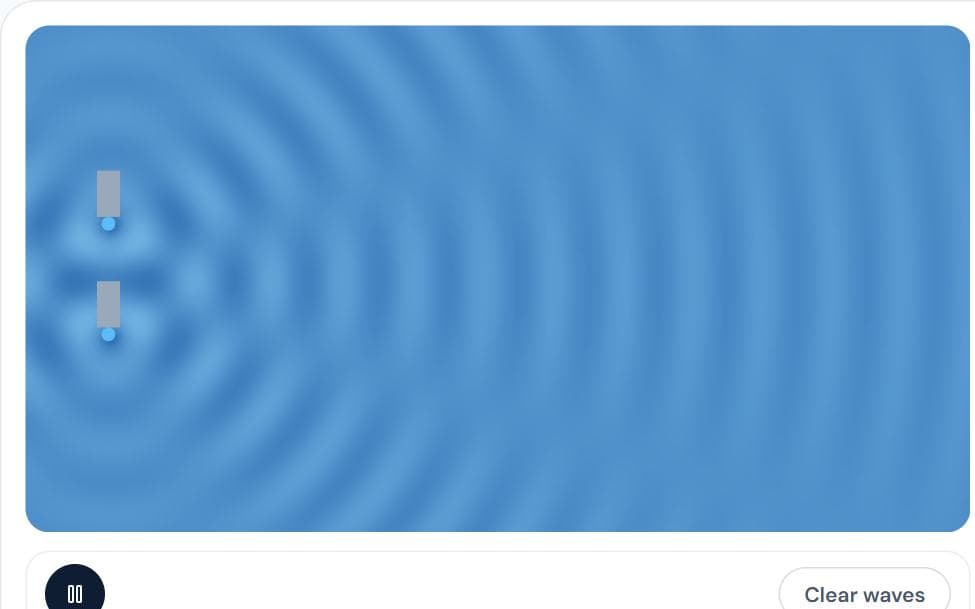
In this sound waves simulation you watch the air as particles or as a pressure map from one speaker, two speakers or a reflecting wall, change frequency and amplitude, move a listener to hear loud and quiet spots, and pump the air out of a box to silence it. It suits Sound in Class 9 and Waves in Class 11.

Also covers: longitudinal wave, compression, rarefaction, pitch, loudness, frequency, vacuum.
Frequently asked questions

Why can't sound travel in a vacuum?

Sound is passed on by molecules bumping into their neighbours. With no molecules there is nothing to carry the wave.

What makes two speakers sound quiet in some places?

Destructive interference: where the path difference is half a wavelength, a compression from one meets a rarefaction from the other.

Is sound transverse or longitudinal?

Longitudinal in air — the molecules move back and forth along the direction the sound travels.