About the Standing Waves simulation
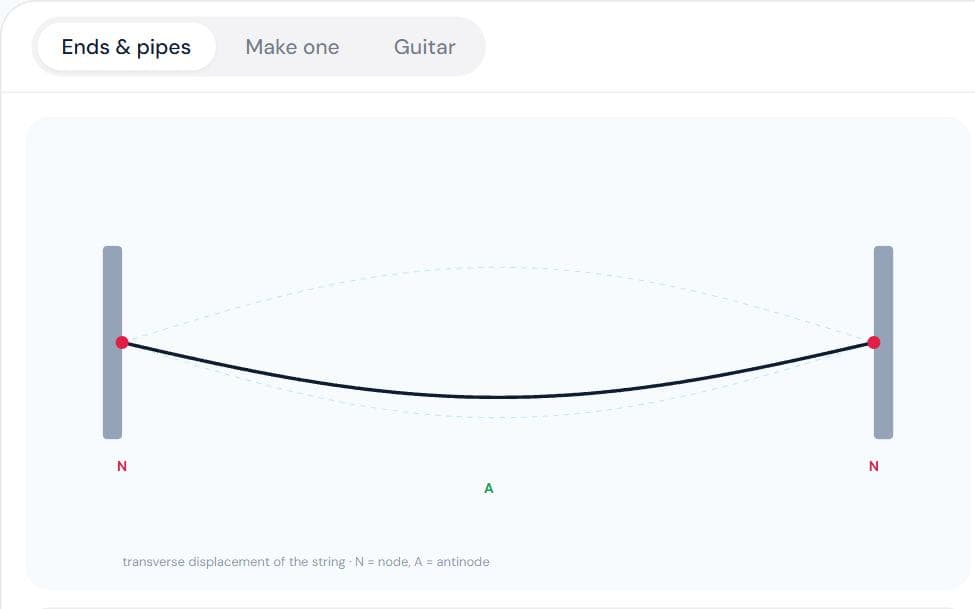
A standing (stationary) wave forms when two identical waves travel through each other in opposite directions — usually a wave and its own reflection. Their sum doesn't travel: some points, the nodes, never move, and the points halfway between, the antinodes, swing the most. Only certain wavelengths fit between the ends, which is why strings and pipes have definite notes.
This standing waves simulation has three screens. Ends & pipes shows the harmonics of a string fixed at both ends, a pipe closed at one end and an open pipe, with the two travelling waves that make each one. Make one drives a string at any frequency so you can watch it build up at resonance. Guitar lets you fret six strings and hear the notes. It covers Waves in Class 11 — the sonometer, organ pipes and resonance-tube questions in JEE and NEET.
Also covers: standing waves, stationary waves, nodes and antinodes, harmonics, overtones, open pipe, closed pipe, organ pipe, sonometer, guitar string, resonance.