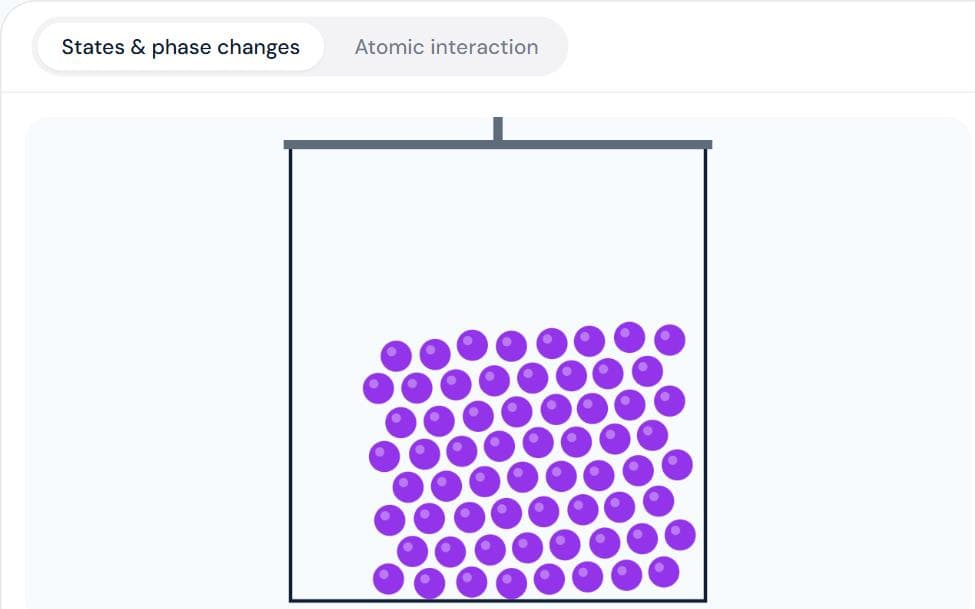
About the States of Matter simulation
Solids, liquids and gases are the same particles with different amounts of energy. In a solid they vibrate about fixed places, held by attractions; in a liquid they slide past each other; in a gas they fly apart. Heating adds energy until the attractions can no longer hold them, which is melting and boiling.
In this states of matter simulation you heat and cool neon, argon, oxygen and water, watch the particles change state, change the container's volume and read a pressure–temperature graph. A second screen plots the potential energy between two atoms and the force between them. It suits Matter in Our Surroundings in Class 9 and Kinetic Theory and Thermal Properties in Class 11.
Also covers: solid liquid gas, phase change, melting, boiling, lennard-jones, atomic interactions, intermolecular forces.