Skip to content
Waves & Sound · Physics

Tuning Fork & Sound Waves Simulation

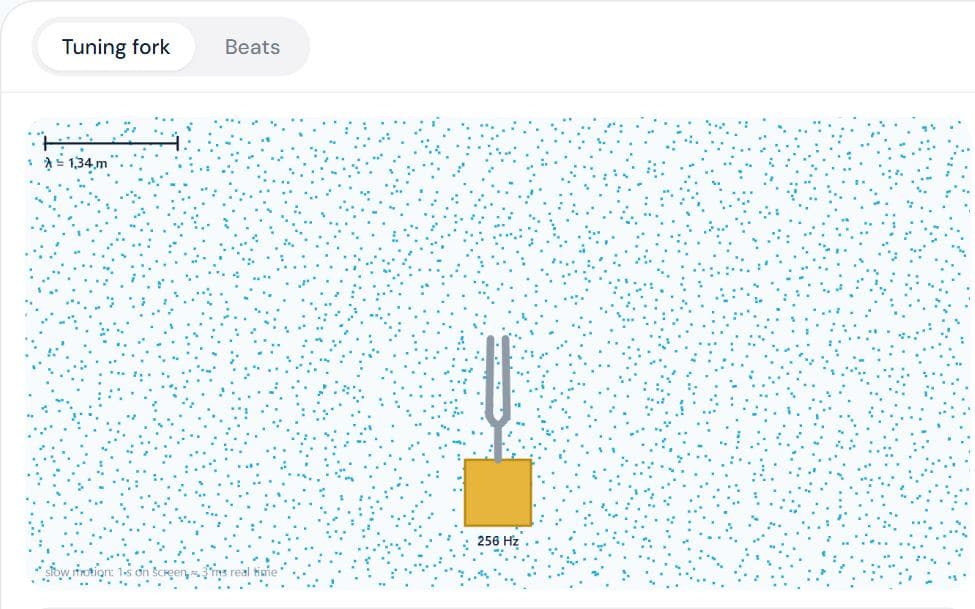
Strike a tuning fork and watch the air molecules around it bunch into compressions and spread into rarefactions. Change the frequency and temperature, hear the note, and put two forks together to hear beats.

Interactive virtual lab · no download · works on phones and laptops

Chapter
Waves
For
Class 9 · 11 · JEE · NEET
Time
~10 min

Tuning Fork & Sound Waves is a Pro simulation

Pro opens all 125 virtual labs — 483 simulations with guides and quizzes.

How to use it

  1. 1Press Strike (or Run) to set the fork vibrating.
  2. 2Change the frequency and the air temperature in the panel.
  3. 3Turn off random molecular motion to see the wave pattern alone; turn on pressure shading to see compressions.
  4. 4Beats tab: tune the second fork and listen.

What to notice

  • The molecules only shake back and forth about their places; the wave — the pattern of compressions — is what travels.
  • Higher frequency → shorter wavelength, since v = fλ and v is fixed by the air.
  • Warmer air carries sound faster: v ≈ 331 + 0.6 T m/s.
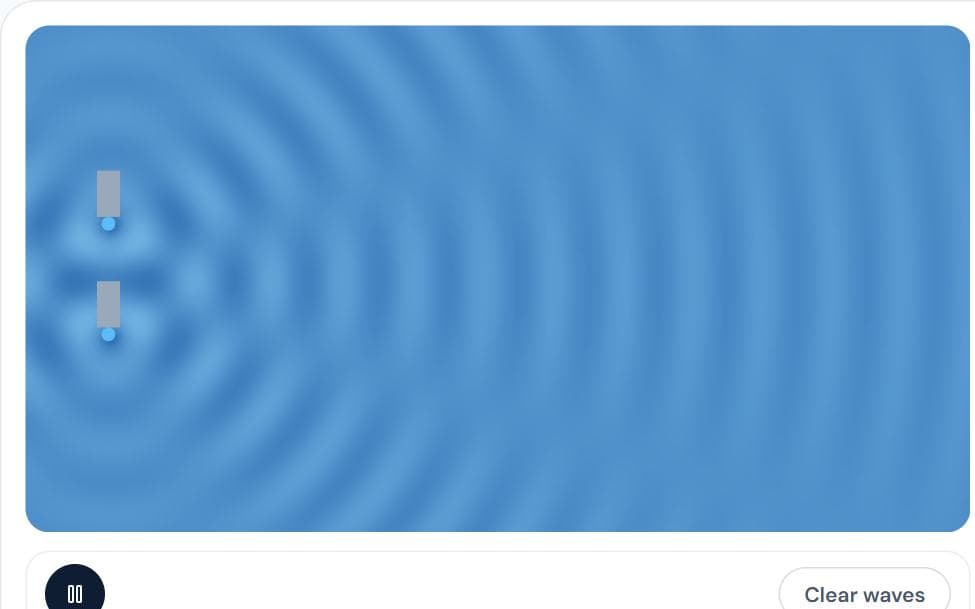
  • Two forks a few hertz apart give beats: the loudness rises and falls |f₁ − f₂| times a second.

For teachers

A ready-made teaching kit comes with this lab

  • Lesson plan

    19 min, 4 steps

  • Ask the class

    3 questions with answers

  • Quick quiz

    6 questions, printable

  • Key formulas

    3 formulas

About the Tuning Fork & Sound Waves simulation

A struck tuning fork vibrates at one fixed frequency, pushing the air around it into compressions and rarefactions that spread outwards as sound. Each air molecule only jiggles back and forth about its place; the compressions are what travel. The speed of sound depends on the air — warmer air carries it faster — and the wavelength follows from v = fλ.

This tuning fork simulation shows thousands of air molecules around a fork on its resonance box. Change the frequency and the air temperature, switch the random thermal motion of the molecules off to see the wave clearly, shade the compressions, and play the real note. The beats screen sounds two forks a few hertz apart. It suits Sound in Class 9 and Waves in Class 11, JEE and NEET.

Also covers: tuning fork, sound wave, longitudinal wave, compression, rarefaction, air molecules, beats, frequency, wavelength, speed of sound.
Frequently asked questions

What is the wavelength of a 256 Hz tuning fork in air?

About 1.34 m, since λ = 343/256 at 20 °C.

What are beats?

When two notes of slightly different frequency sound together, the loudness rises and falls |f₁ − f₂| times a second.

Why does a tuning fork make a pure note?

Its two prongs vibrate in one simple mode, so it produces mainly a single frequency with very few overtones.