Skip to content
Waves & Sound · Physics

Wave on a String Simulation

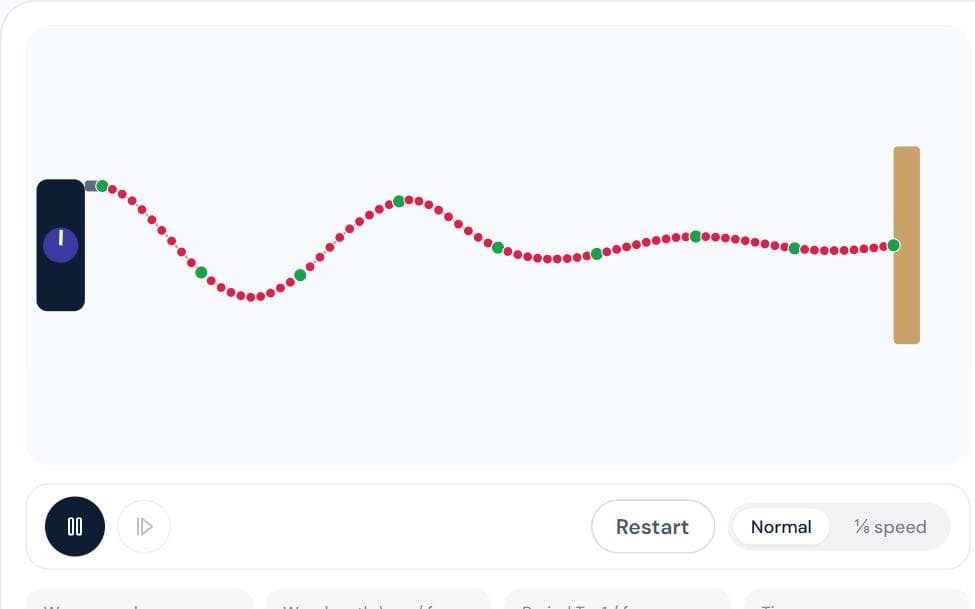
Wiggle the end of a string, pulse it, or drive it with an oscillator. Change tension and damping, fix or free the far end, and build standing waves.

Interactive virtual lab · no download · works on phones and laptops

Chapter
Waves
For
Class 11 · JEE · NEET
Time
~12 min

Wave on a String is a Pro simulation

Pro opens all 125 virtual labs — 483 simulations with guides and quizzes.

How to use it

  1. 1Choose manual, oscillate or pulse.
  2. 2Drag the wrench in manual mode.
  3. 3Set frequency, amplitude, damping and tension.
  4. 4Choose a fixed end, a loose end or no end.
  5. 5Use the rulers and the timer to measure λ and T.

What to notice

  • Each bead only moves up and down; the wave carries energy along the string.
  • A pulse reflects inverted from a fixed end and upright from a loose end.
  • Higher tension → faster wave.
  • At the right frequencies the reflected wave builds standing waves with nodes.

For teachers

A ready-made teaching kit comes with this lab

  • Lesson plan

    20 min, 4 steps

  • Ask the class

    3 questions with answers

  • Quick quiz

    6 questions, printable

  • Key formulas

    3 formulas

About the Wave on a String simulation

Shake one end of a string and a wave travels along it. The string itself only moves up and down; what travels is the shape. How fast it travels depends on the string — its tension and how heavy it is per metre — while the frequency is set by your hand, and the wavelength follows from the two.

In this wave on a string simulation you wiggle the end by hand, send a single pulse or drive it with an oscillator, and change amplitude, frequency, damping and tension. Choose a fixed end, a loose end or no end to see reflections and standing waves, and use the rulers and timer to measure wavelength and period. It covers Waves in Class 11 and the string questions in JEE and NEET.

Also covers: transverse wave, standing waves, reflection, fixed end, loose end, tension, damping.
Frequently asked questions

What happens to the wavelength if you increase the frequency?

It gets shorter. The speed is fixed by the string, so if f goes up, λ = v/f goes down.

How does a pulse reflect from a fixed end?

Upside down (a phase change of π). From a loose end it reflects the same way up.

Does increasing the amplitude change the wave speed?

No. Speed depends on tension and mass per unit length, not on how big the wave is.