Skip to content
Stereochemistry · Chemistry

Conformations of Ethane & Butane Simulation

Turn the C–C bond of ethane or butane and watch the 3D model, the Newman projection and the energy curve move together: staggered and eclipsed, anti, gauche and fully eclipsed. Then see the case where gauche beats anti.

Interactive virtual lab · no download · works on phones and laptops

Chapter
Isomerism
For
Class 11 · JEE · NEET
Time
~10 min

Conformations of Ethane & Butane is a Pro simulation

Pro opens all 125 virtual labs — 483 simulations with guides and quizzes.

How to use it

  1. 1Pick ethane, butane or the diol.
  2. 2Drag the dihedral slider or press a named conformation.
  3. 3Press Play to spin the back carbon and watch the energy dot.

What to notice

  • Ethane: staggered is 12 kJ/mol below eclipsed (torsional strain only).
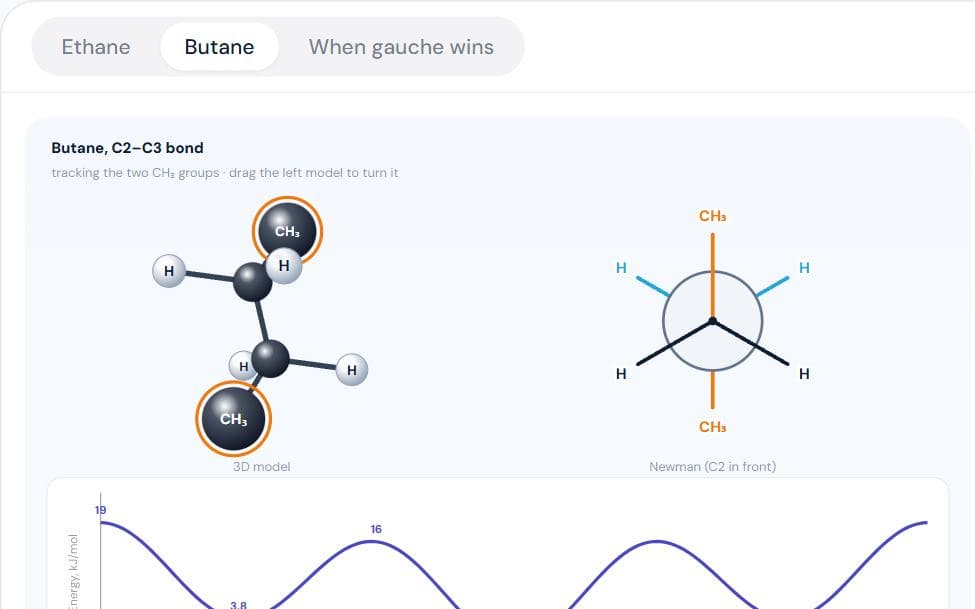
  • Butane: anti (0) < gauche (3.8) < partially eclipsed (16) < fully eclipsed (19 kJ/mol).
  • Gauche is staggered too; the least stable form is fully eclipsed, CH₃ behind CH₃.
  • Conformers interconvert millions of times a second: they are not separate compounds.
  • In ethane-1,2-diol gauche is more stable than anti because of an internal H-bond.

For teachers

A ready-made teaching kit comes with this lab

  • Lesson plan

    18 min, 4 steps

  • Ask the class

    4 questions with answers

  • Quick quiz

    5 questions, printable

  • Key formulas

    2 formulas

About the Conformations of Ethane & Butane simulation

Conformations are the different shapes a molecule takes as it rotates about a single bond. In ethane the staggered conformation, with the C–H bonds of the two carbons as far apart as possible, is about 12 kJ/mol lower than the eclipsed one; that energy is torsional strain. Butane adds steric strain between the two methyl groups: the anti form (180°) is lowest, gauche (60°) about 3.8 kJ/mol higher, the partially eclipsed form (120°) about 16 and the fully eclipsed form (0°) about 19 kJ/mol.

This conformations simulation for ethane and butane turns the C–C bond and moves three pictures together: a 3D model (or a Sawhorse projection), the Newman projection and the potential-energy curve, with the current conformation named and the distance between the two methyl groups shown. Press a named conformation to jump to it or press Play to spin the bond. A third tab shows the exception students get asked about: in ethane-1,2-diol the gauche form is more stable than anti, because the two OH groups are close enough to hydrogen-bond.

Also covers: conformational isomerism, conformational analysis, staggered and eclipsed, anti gauche syn, butane conformations, ethane conformations, torsional strain, steric strain, dihedral angle, potential energy diagram, gauche effect, ethylene glycol conformation.
Frequently asked questions

Why is the staggered conformation of ethane more stable than the eclipsed one?

In the staggered form the C–H bonds on neighbouring carbons are as far apart as possible, so torsional strain (repulsion between bonding electron pairs) is smallest.

What is the most and least stable conformation of butane?

Anti (CH₃ groups 180° apart) is the most stable; fully eclipsed (CH₃ behind CH₃, 0°) is the least stable. Gauche lies in between because the methyl groups are 60° apart.

Can conformational isomers be separated?

Not at room temperature. The barriers are small (about 12–19 kJ/mol), so the conformations interconvert millions of times a second.

Why is gauche more stable than anti in ethylene glycol?

In the gauche form the two OH groups are close enough to form an intramolecular hydrogen bond, which outweighs the small steric cost.