About the Geometrical Isomerism: Cis–Trans & Allenes simulation
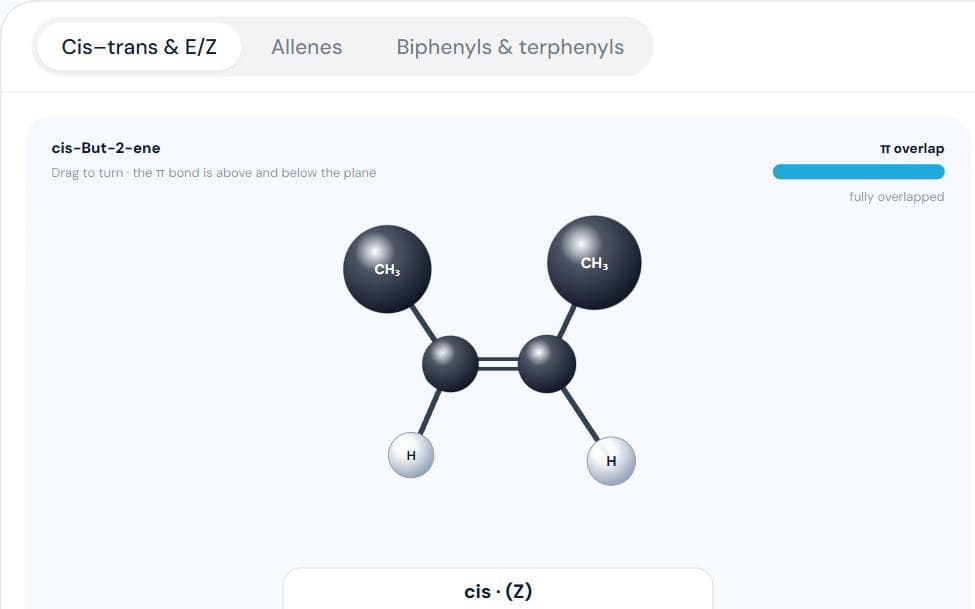
Geometrical (cis–trans) isomerism appears when rotation about a bond is restricted and each end carries two different groups. A C=C double bond is rigid because its π bond needs the p orbitals on both carbons to stay parallel: twisting one end by 90° destroys the overlap, which costs about 250–270 kJ/mol. So cis-but-2-ene and trans-but-2-ene are separate compounds. When groups are not repeated across the bond, or when cis/trans disagrees with priorities, the E/Z system decides: Z when the higher-priority groups (by CIP rules) are on the same side, E when they are opposite.
This geometrical isomerism simulation lets you build an alkene from any four groups, twist the C=C slowly and watch the π overlap fall to zero, flip the whole molecule to see that cis stays cis, and turn on CIP priorities to see why cis-2-bromobut-2-ene is E. The Allenes tab shows why an even number of cumulated double bonds puts the two ends in perpendicular planes (optical isomers with no chiral carbon) while an odd number keeps them in one plane (cis/trans). The Biphenyls tab locks or frees the rings with ortho groups: planar or non-planar, chiral biphenyls and cis/trans terphenyls.
Also covers: geometrical isomerism, cis trans isomerism, e z nomenclature, e/z, restricted rotation, allene, cumulene, axial chirality, biphenyl, atropisomerism, terphenyl, planar and non planar, ortho substituted biphenyl, optical activity without chiral carbon.