Skip to content
Organic Reactions · Chemistry

SN2 Reaction Mechanism Simulation

Watch a nucleophile attack an alkyl halide from the back, one step at a time: curved arrows, moving electron pairs, the transition state and the umbrella flip. Change the substrate, nucleophile, leaving group and solvent, then draw the mechanism from memory.

Interactive virtual lab · no download · works on phones and laptops

Chapter
Haloalkanes & Haloarenes
For
Class 12 · JEE · NEET
Time
~15 min

SN2 Reaction Mechanism is a Pro simulation

Pro opens all 125 virtual labs — 483 simulations with guides and quizzes.

How to use it

  1. 1Mechanism: press Next step. With Predict on, answer before each step is shown.
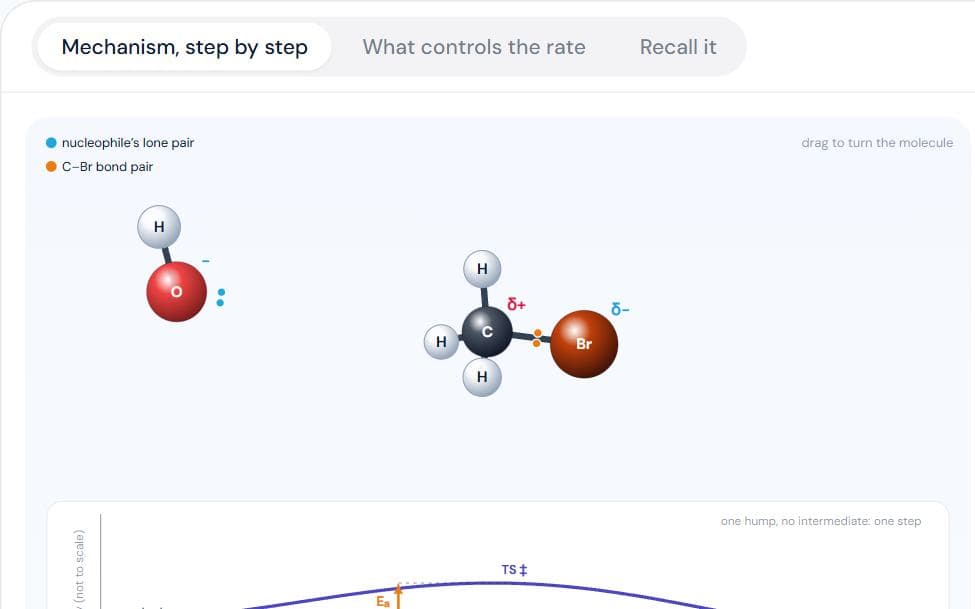
  2. 2Drag the molecule (or use Turn) to see the umbrella in 3D; scrub the reaction coordinate.
  3. 3Turn on the σ* orbital to see why the attack comes from the back.
  4. 4What controls the rate: change the substrate, nucleophile, leaving group and solvent.
  5. 5Recall it: draw the two curved arrows, then put the six steps in order.

What to notice

  • The nucleophile attacks 180° from the leaving group: backside attack.
  • Bond making and breaking happen together in one step; the energy profile has one hump and no intermediate.
  • At the transition state carbon has five partial or full bonds, with the other three groups flat in a plane.
  • The three groups flip like an umbrella: (R)-2-bromobutane gives (S)-butan-2-ol.
  • CH₃X > 1° > 2° ≫ 3°: a tertiary carbon is covered at the back and does not react by SN2.
  • I⁻ is the best leaving group of the halides and F⁻ the worst; rate = k[RX][Nu].

For teachers

A ready-made teaching kit comes with this lab

  • Lesson plan

    23 min, 4 steps

  • Ask the class

    5 questions with answers

  • Quick quiz

    7 questions, printable

  • Key formulas

    4 formulas

About the SN2 Reaction Mechanism simulation

SN2 means substitution, nucleophilic, bimolecular. A nucleophile — an electron-rich species such as OH⁻, CN⁻ or I⁻ — replaces the halogen of an alkyl halide in a single step. It attacks the carbon from the side opposite the halogen (backside attack), the new bond forms as the old one breaks, and the three other groups on carbon flip over like an umbrella in the wind. That flip is the Walden inversion: a chiral substrate gives the product with the inverted configuration.

This SN2 reaction simulation plays the mechanism one step at a time on a 3D model you can turn. The nucleophile's lone pair and the C–X bond pair are drawn as coloured dots, so the two curved arrows show real electrons moving. With Predict on, it asks you what happens before each step. A second mode compares substrates (methyl, 1°, 2°, neopentyl, 3°), nucleophiles, leaving groups and solvents, and a recall mode asks you to draw the arrows and order the steps from memory.

Also covers: sn2, nucleophilic substitution, bimolecular, backside attack, walden inversion, inversion of configuration, transition state, haloalkane, alkyl halide, leaving group, nucleophile, curved arrow, finkelstein, polar aprotic solvent, steric hindrance.
Frequently asked questions

Why does the nucleophile attack from the back in SN2?

The empty σ* orbital of the C–X bond has its large lobe on the side of carbon away from X, and the front is crowded by X and its lone pairs. Attack from the back puts the incoming electrons into σ*, which weakens and breaks the C–X bond.

Why do tertiary alkyl halides not undergo SN2?

Three alkyl groups cover the back of the carbon, so the nucleophile cannot reach it (steric hindrance). Tertiary halides react by SN1, through a carbocation, or eliminate by E2.

What is the transition state of an SN2 reaction?

A trigonal bipyramidal arrangement: the nucleophile and leaving group are partly bonded to carbon on opposite sides, the other three groups lie flat in a plane, and the negative charge is spread over both ends. It is the top of the energy barrier and cannot be isolated.

Why is SN2 faster in polar aprotic solvents like acetone or DMSO?

Protic solvents such as water hydrogen-bond to the anionic nucleophile and hold it back. Aprotic solvents cannot, so the nucleophile is free and reacts faster. This is also why the halide nucleophile order flips: I⁻ > F⁻ in water, F⁻ > I⁻ in DMSO.

Does SN2 always change R to S?

It always inverts the shape. The label changes from R to S only if the incoming group takes the leaving group's place in the CIP priority order, as when OH⁻ replaces Br in 2-bromobutane.