Skip to content
Stereochemistry · Chemistry

Newman, Sawhorse & Fischer Projections Simulation

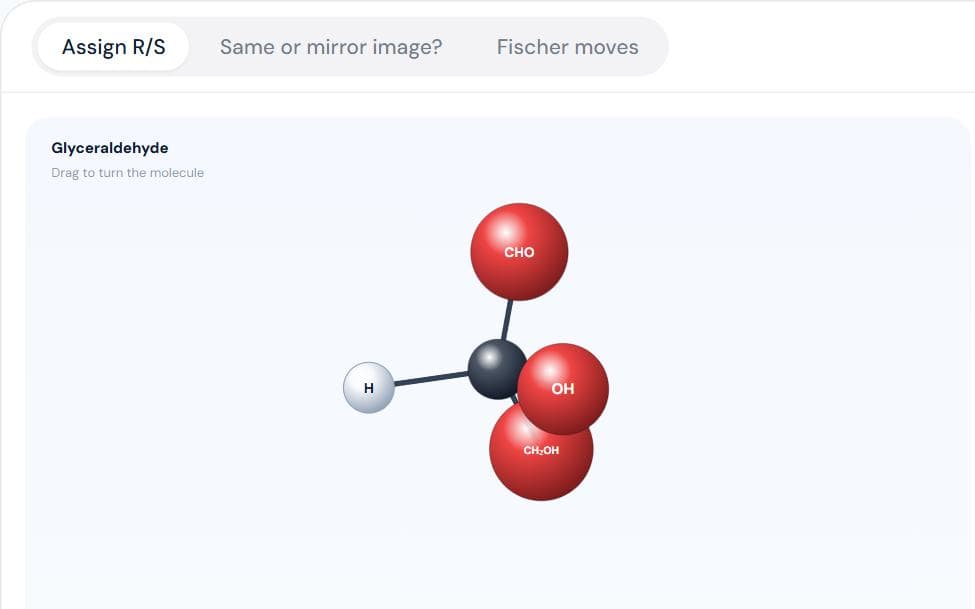
See one molecule as a Newman, a Sawhorse and a Fischer projection, and convert any one into any other step by step: the camera moves, the back carbon turns to eclipsed, the drawing flattens — and the R/S labels never change.

Interactive virtual lab · no download · works on phones and laptops

Chapter
Isomerism
For
Class 11 · Class 12 · JEE · NEET
Time
~15 min

Newman, Sawhorse & Fischer Projections is a Pro simulation

Pro opens all 125 virtual labs — 483 simulations with guides and quizzes.

How to use it

  1. 1Views: choose 3D, Newman, Sawhorse or Fischer, and turn the back carbon.
  2. 2Convert: pick a route (e.g. Newman → Fischer) and press Next step.
  3. 3On Newman → Fischer from the anti form, tick “Show the common mistake”.

What to notice

  • All three projections are views of the same 3D molecule.
  • A Fischer projection is always the eclipsed form, with the chain ends pointing away.
  • In a Fischer projection horizontal bonds come towards you, vertical bonds go away.
  • Turning a single bond (the conformation) never changes R/S.
  • Copying left and right from a staggered Newman without eclipsing first gives the wrong stereoisomer.

For teachers

A ready-made teaching kit comes with this lab

  • Lesson plan

    21 min, 4 steps

  • Ask the class

    4 questions with answers

  • Quick quiz

    5 questions, printable

  • Key formulas

    2 formulas

About the Newman, Sawhorse & Fischer Projections simulation

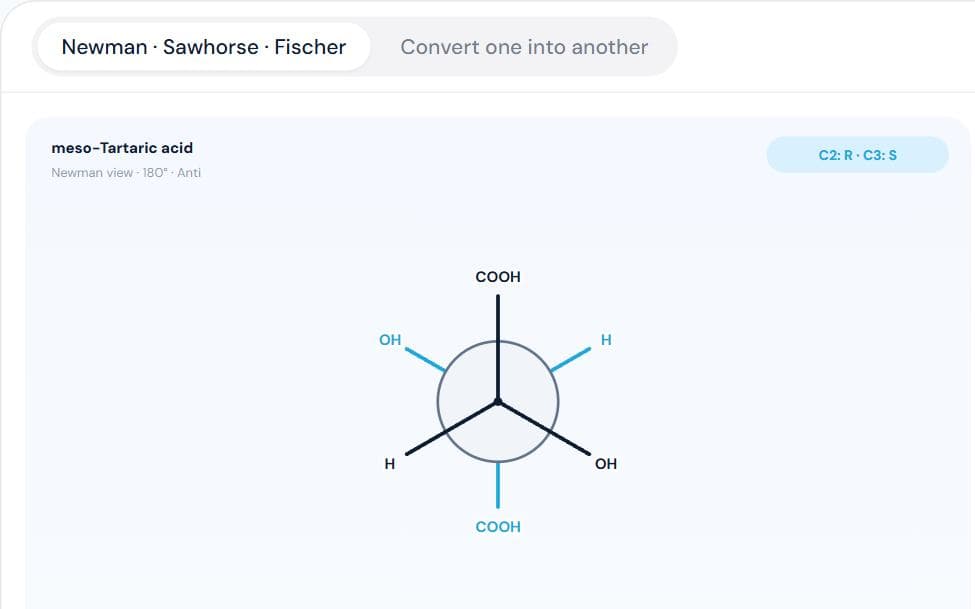
Newman, Sawhorse and Fischer projections are three ways of drawing the same three-dimensional molecule on paper. A Newman projection looks straight down a C–C bond: the front carbon's bonds meet at the centre and the back carbon is a circle. A Sawhorse projection shows the same bond at an angle, front carbon lower-left. A Fischer projection puts the carbon chain vertical with every vertical bond going away from you and every horizontal bond coming towards you; it always shows the eclipsed conformation.

This Newman, Sawhorse and Fischer projection simulation draws all three from one 3D model, so they can never disagree, and converts any projection into any other step by step: the camera moves, the back carbon turns to the eclipsed form when a Fischer projection is the target, and the drawing flattens into the cross. The R/S labels of both stereocentres stay on screen and never change, because turning a single bond or changing the drawing does not change the molecule. A “common mistake” view shows what happens if you copy left and right straight from a staggered Newman: the wrong stereoisomer.

Also covers: newman projection, sawhorse projection, fischer projection, interconversion of projections, newman to fischer, fischer to newman, sawhorse to fischer, newman to sawhorse, wedge dash, erythro threo, eclipsed form.
Frequently asked questions

How do you convert a Newman projection into a Fischer projection?

Rotate the back carbon until the two chain-end groups are eclipsed (pointing the same way), turn the molecule so the C–C bond is vertical with those groups pointing away, then draw the horizontal groups on each carbon left and right.

Why is a Fischer projection always eclipsed?

Both vertical bonds at every centre point away from the viewer, which is only possible when the backbone curls round in the eclipsed conformation.

What is the difference between Newman and Sawhorse projections?

Both show the same conformation of a C–C bond. Newman looks straight along the bond so the back carbon hides behind the front one; Sawhorse looks at it obliquely so both carbons and all six bonds are visible.

Does converting between projections change R and S?

No. A projection is only a way of drawing the molecule. If R/S changes after a conversion, a group was put on the wrong side.