Skip to content
Stereochemistry · Chemistry

Plane & Centre of Symmetry (Chirality) Simulation

Test a plane or a centre of symmetry the honest way: send every atom through it, one at a time, and see whether an identical atom is waiting. Clear up the classic confusions — meso compounds, a centre with no plane, a C₂ axis that does not count, allenes.

Interactive virtual lab · no download · works on phones and laptops

Chapter
Isomerism
For
Class 11 · Class 12 · JEE · NEET
Time
~15 min

Plane & Centre of Symmetry (Chirality) is a Pro simulation

Pro opens all 125 virtual labs — 483 simulations with guides and quizzes.

How to use it

  1. 1Plane of symmetry: pick a molecule, pick a plane, press “Reflect every atom”.
  2. 2Centre of symmetry: the same, sending each atom through the centre.
  3. 3Drag to turn the molecule; tick “Show C₂ axes” to see the axis that fools students.
  4. 4Chiral or not?: answer first, then press “Show me”.

What to notice

  • One plane OR one centre of symmetry is enough to make a molecule achiral.
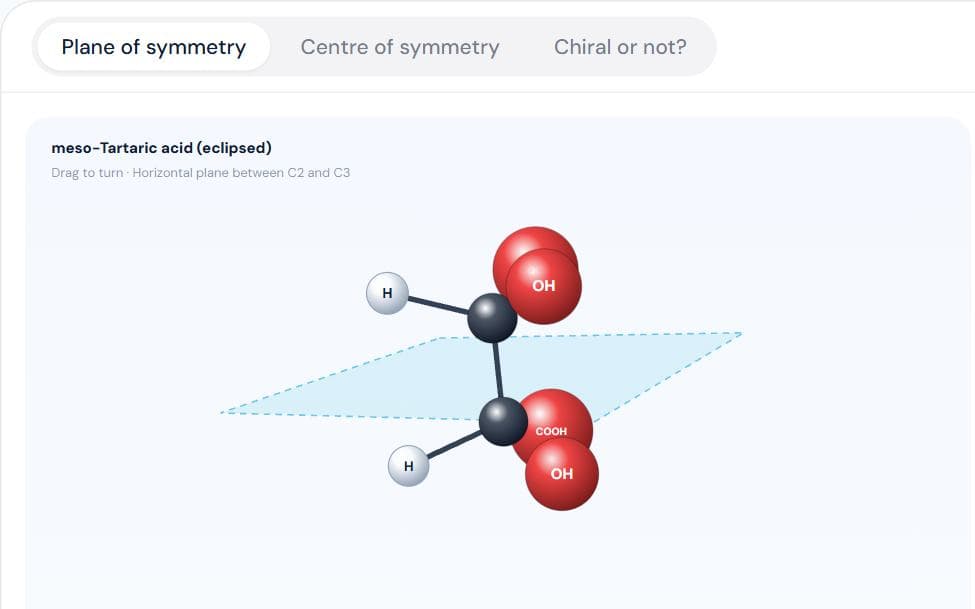
  • Meso-tartaric acid has a plane in the eclipsed form and a centre in the anti form.
  • A molecule can have no plane but a centre of symmetry, and still be achiral.
  • A C₂ axis alone does not make a molecule achiral: (R,R)-tartaric acid is chiral.
  • Chiral centres are neither needed nor enough: allenes are chiral, meso compounds are not.

For teachers

A ready-made teaching kit comes with this lab

  • Lesson plan

    22 min, 4 steps

  • Ask the class

    4 questions with answers

  • Quick quiz

    6 questions, printable

  • Key formulas

    2 formulas

About the Plane & Centre of Symmetry (Chirality) simulation

A molecule is chiral when it cannot be superimposed on its mirror image. In practice you check for a plane of symmetry (a mirror plane that cuts the molecule into two mirror-image halves) or a centre of symmetry (a point through which every atom has an identical twin at the same distance on the other side). Either one makes the molecule achiral. A rotation axis such as C₂ does not: (2R,3R)-tartaric acid has a C₂ axis and is chiral.

This plane and centre of symmetry simulation tests each element honestly: choose a plane or the centre and send every atom through it, one at a time; a tick means an identical atom is waiting there, a cross means the element fails. The examples are the confusing ones: meso-tartaric acid, which has a plane in its eclipsed form but only a centre in its anti form; 2,4-dimethylcyclobutane-1,3-dicarboxylic acid with a centre and no plane; trans-1,2-dimethylcyclopropane with only a C₂ axis; and an allene that is chiral with no chiral carbon. A trainer asks “chiral or achiral?” and shows the element afterwards.

Also covers: plane of symmetry, centre of symmetry, center of symmetry, pos cos, meso compound, chiral or achiral, optical isomerism, tartaric acid, c2 axis, dissymmetry, symmetry elements.
Frequently asked questions

Why is meso-tartaric acid optically inactive although it has two chiral centres?

Its two halves are mirror images of each other: the eclipsed form has a plane of symmetry and the anti form a centre of symmetry. The rotation produced by one half is cancelled by the other.

Can a molecule without a plane of symmetry be achiral?

Yes, if it has a centre of symmetry. The anti conformation of meso-tartaric acid and 2,4-dimethylcyclobutane-1,3-dicarboxylic acid are standard examples.

Does a C₂ axis make a molecule achiral?

No. Proper rotation axes are compatible with chirality. Only a plane, a centre or an improper rotation axis makes a molecule superimposable on its mirror image.

Which conformation should I check for symmetry?

Any one the molecule can reach by rotating single bonds. If one accessible conformation is achiral, the compound is optically inactive, even if the drawn conformation has no symmetry.